
How to Build an Influencer Program: A Step-by-Step Guide for Brands
See how LeadDyno can take your affiliate marketing strategy to the next level. Let’s set up a 1:1 demo to get your questions answered.
Manage creator referrals, track sales, and reward your top-performing influencers, all in one place with LeadDyno.
Brands are investing heavily in influencer programs, and it’s easy to see why. Recommendations from people customers already trust can introduce a product, build credibility, and drive sales. Unlike a one-off collaboration, a well-structured program also lets you build on those results.
Most brands start the same way: they send a free product to someone, that person posts about it, and a few sales come in. Then they repeat it with someone else. After a while, it gets hard to tell which partnerships actually paid off. That’s usually the moment a string of one-off deals needs to become a real program.
In this guide, we’ll walk through how to build an influencer program from scratch, including setting your budget, recruiting the right creators, managing partnerships, and tracking what’s working.
What is an Influencer Program?
An influencer program is an ongoing system a brand uses to recruit, manage, track, and pay a group of influencers who promote its products. Instead of negotiating every post from scratch, you set the rules once (what influencers do, how they get paid, and how you measure results) and apply them to everyone who joins.
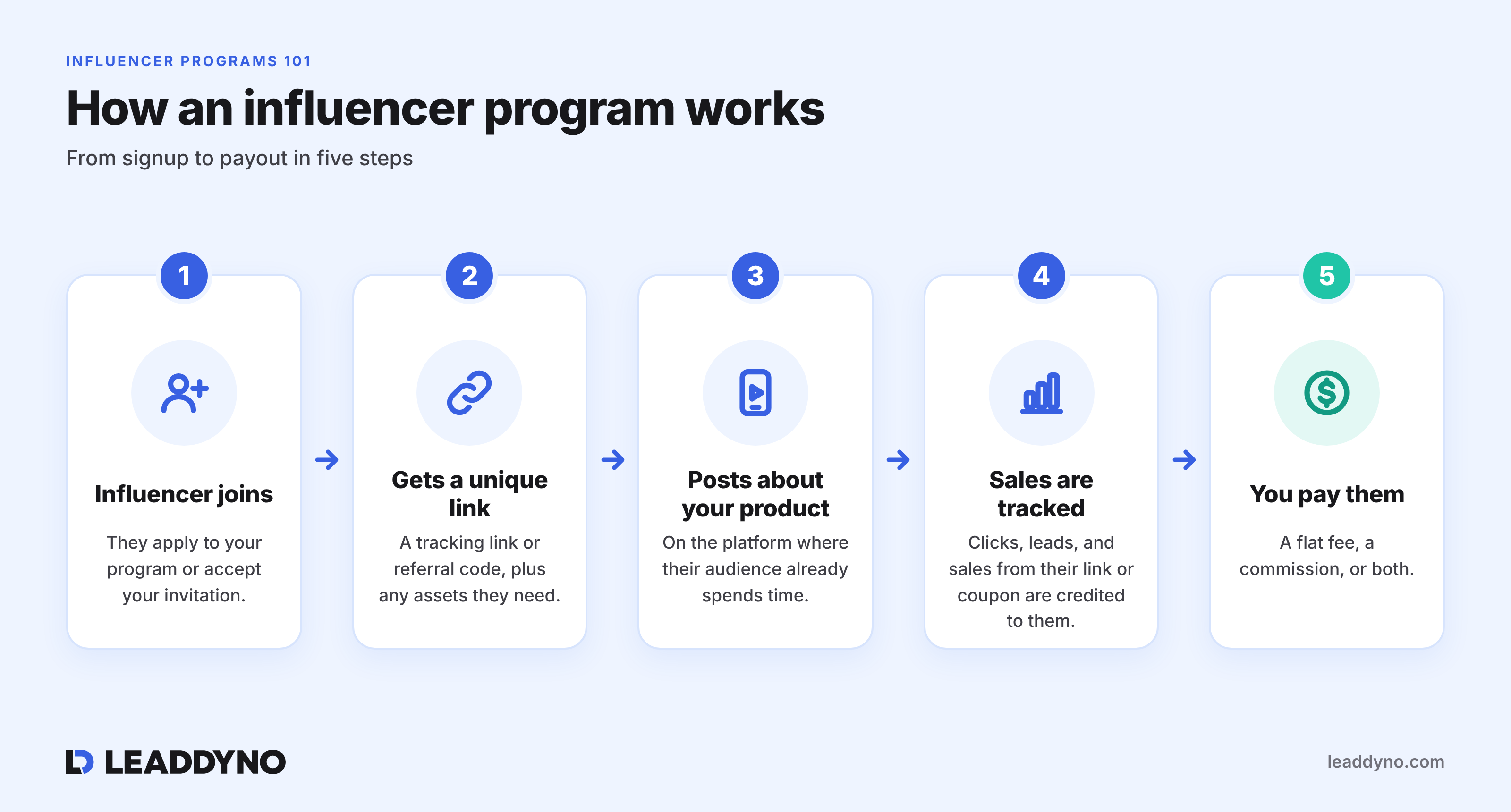
Here's how it works in practice:
- An influencer applies or accepts your invitation.
- They get a unique tracking link or referral code, plus any assets they need.
- They post about your product.
- Sales and leads from their audience are tracked back to them.
- You pay them a flat fee, a commission, or both.
Influencer program vs. campaign
A campaign is a push around one goal with an end date. A program keeps running and gets better as you learn from it.
Worth saying that inside a Influencer program, you can also run influencer campaigns, like a holiday push with a bonus commission. The program is the structure those campaigns sit on.
Step 1: Define your goals and target audience
Start with what you want the program to do. While "more sales and brand awareness" are perfectly reasonable goals, they're too broad to help you make decisions about creators, budgets, and performance.
Start by identifying one primary objective. For example:
- Brand awareness: Introduce your business to people who haven't heard of it. Focus on reach, relevant impressions, and audience engagement.
- Website traffic: Encourage potential customers to visit your store or landing pages. Track referral traffic, link clicks, and visitor behavior.
- Sales: Generate purchases through creator recommendations. Measure attributed orders, revenue, conversion rates, and acquisition costs.
- Lead generation: Encourage demo bookings, free trial signups, or other qualified leads, particularly for B2B and SaaS businesses.
- Content: Generate more user-generated content usable photos and videos.
Pick one main goal, and one secondary goal at most. Because each goal calls for different pay. Then turn the goal into a number and a date. For example: 15 active influencers and $10,000 in tracked sales within the first 90 days.
Define your target audience
You should get specific about your audience. You're not looking for the biggest account in your niche. You're looking for people whose followers look like your customers.
Look at your customers and consider: What are they interested in? What problems does your product solve? Where do they discover new products? Whose recommendations do they trust?
A sustainable skincare brand, for instance, might find more value in partnering with a creator who regularly discusses low-waste beauty routines than a general lifestyle influencer with ten times as many followers.
Then write a short ideal influencer profile.
For a skincare brand, it might read: skincare content on Instagram or TikTok, 5K to 50K followers, honest ingredient-focused reviews, audience mostly in the US and Canada.
You'll use this profile in Step 5 to decide who's worth a message.
Step 2: Set your budget and compensation model
Unfortunately, there's no universal answer about how much should you pay influencers. But mostly important, you need to decide what you can spend.
You need to count product costs (at your cost, not retail price), fulfillment expenses, software and fees, and your own time.
The point isn't to find the lowest commission possible. It's to offer compensation that makes partnerships attractive without putting your profit margins at risk.
If you want benchmarks for flat fees by follower tier, our influencer pricing guide covers them.
Types of compensation models
After figuring out how much you can spend, you need to choose your compensation model. There are four common approaches:
For most brands starting out, we'd suggest commission. The commission ties pay to results, which keeps your risk low while you learn what works.
If you're choosing a structure, two are worth a close look for influencers: A hybrid commission gives influencers a base amount plus a percentage, and a tiered commission raises the rate as their sales grow. Our guide to affiliate commission structures explains each type and when it fits.
Step 3: Set up your program
With goals and pay decided, you can build the program itself. At a minimum you need:
- Someone who owns the program
- A way to track each influencer's results
- A signup page
- Written terms
- A way to pay people
You can run a handful of influencers with a spreadsheet and discount codes. It stops working once you have more than a few people, because you're matching orders to influencers by hand and one missed sale means an unhappy partner. That's the point where affiliate software earns its keep.
Set up tracking and influencer management
If you're offering performance-based compensation, reliable tracking is essential.
Each influencer should have a unique affiliate link or referral code that helps connect their promotions to customer activity.
For example, a creator named Lola might share a referral link in her Instagram bio and a personalized discount code like Lola15 in a Reel.
When customers purchase through those tracked referrals, your system can associate eligible sales with Lola according to your program's attribution settings.
This is where a tool like LeadDyno comes in.
LeadDyno helps brands set up and manage affiliate-style influencer programs without having to build their own tracking and commission systems. Here's how that looks in practice:
- Commission plan: Build the plan from Step 2 (percentage, flat, tiered, recurring, per-product, or hybrid). You can see the reward structure options in our help docs. How many plans you can run depends on your LeadDyno plan.
- Tracking: Every influencer gets a unique affiliate link, so clicks, leads, and sales are credited to them. LeadDyno works with Shopify, WooCommerce, BigCommerce, Stripe, and other integrations.
- Affiliate groups: If you want influencers on different terms than your regular affiliates, put them in their own group with their own commission plan.
Set up the influencer experience
This is everything influencers see and use before and after they join: where they apply, what they agree to, and where they check their results. Getting it right up front means fewer questions later.
- Signup page: A place where influencers can apply or accept your invitation. Keep the form short: name, email, social handles, and maybe one question about why they like your product. For an influencer program, we'd lean toward manual approval so you can vet each person first.
- Program terms: Keep them short. Cover what influencers can and can't say, when and how you pay, how long a commission applies, and what gets someone removed from the program. A glossary entry on affiliate agreements shows what these usually include, and brand guidelines tell influencers how to use your logo and messaging.
- Influencer dashboard: Influencers log in to find their links and marketing materials, and to see their clicks and commissions without having to ask you. Add your logo and colors so it feels like part of your brand.
- Communication: You can set automated emails such as welcome messages, affiliate newsletters, and stats updates go out automatically, so you're not messaging everyone one by one.
Set up payouts
Decide three things before launch:
- Payment threshold: the minimum an influencer has to earn before a payout.
- Payment frequency: monthly is common.
- Payment method: what you'll use to send the money.
Make sure influencers knows about it. Surprises about money are the fastest way to lose a partner.
One more practical tip: pay commissions after your return window closes, so you're not paying on sales that come back as refunds or chargebacks. Extra incentives like bonuses for hitting a sales goal can come later.
Test it!
Before recruiting your first creators, test everything. Click a test referral link, complete a test purchase through your connected store, and verify that the referral and commission appear correctly. If you're using discount codes, test those as well, since code-based tracking depends on your ecommerce integration.
{{blog-custom-cta}}
Step 4: Pick your influencer types and platforms
In the image below, you can see influencer tiers by following size. Not all influencers are the same, and the biggest creator isn't necessarily the best fit for your business.
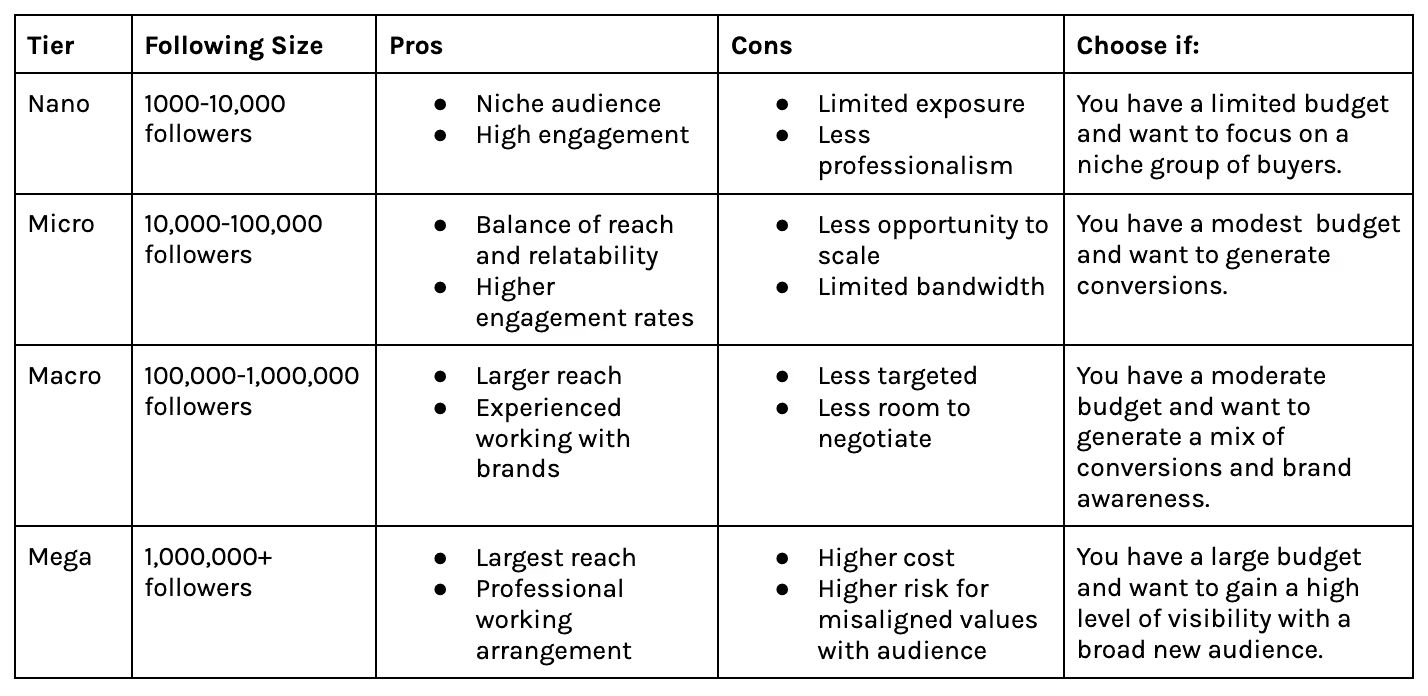
For a new program, we'd start with nano and micro influencers, plus your own customers who already post about you.
Match the platform to how people buy
Not only the influencer niche and audience is important. The platform where they have an audience also matters.
Each of the social media platforms for affiliate marketing tends to suit different kinds of products, mostly because people shop differently on each one.
For example, while TikTok might be a great place for visual and impulse-friendly products, YouTube is better for products people research before buying, like higher-priced items.
Content lifespan matters too. Research summarized by Martech Zone puts the half-life of an Instagram post at about 20 hours, a YouTube video at about 8.8 days, and a Pinterest pin at about 3.8 months. That means Instagram and TikTok influencers need to post often to keep sales coming, while YouTube and Pinterest content keeps working long after it's published.
Step 5: Find and recruit your first influencers
Finding people is mostly manual at this stage: searching, saving profiles in a spreadsheet, and checking each one against the profile you wrote in Step 1. Good places to look:
- Niche hashtags and relevant content: Search for creators discussing subjects directly related to your products.
- Creators engaging with similar brands: Explore partnerships and conversations happening in your industry.
- Industry experts and educators: Look beyond traditional social media personalities. Bloggers, consultants, and specialists can influence buying decisions too.
- Creator discovery platforms: Use influencer databases if you need to search by audience demographics, location, or niche at a larger scale.
Check and evaluate profiles
Before reaching out, spend some time reviewing each creator's content. A five-minute check is enough:
- Read the comments. Look for real questions, not just emojis.
- Compare likes to followers. A big account with very few likes may have bought followers.
- Check the content fit. Do they already talk about problems your product solves?
- Look at past brand posts. A few thoughtful partnerships are a good sign. A feed packed with ads suggests their audience may tune out.
- Watch for disclosure. Do they label paid posts?
Then, create a list of the ones you judge that worth reaching out.
Reach out with something specific
Once you've created a shortlist, reach out with a specific proposal and avoid sending the same generic message to dozens of creators.
Here's a simple example:
Hi Lola! I came across your recent video about simplifying your skincare routine and really liked how you explained the products you use.
I'm reaching out from [Brand], a skincare company focused on refillable products. I think our starter kit could be a great fit for your audience, and we'd love to explore a paid partnership with you.
Would you be interested in hearing more about our influencer program?
Thanks!
It names the content, makes the offer clear, and asks a yes-or-no question.
Start with a group small enough to manage personally. You'll learn more from working closely with a few influencers than from signing up a hundred you never talk to.
Step 6: Onboard influencers
You've recruited your first group of creators. Congratulations!
But don't expect everything else to fall into place automtically from there.
A good onboarding process helps influencers understand your product, your expectations, and how the partnership works.
Make It easy for influencers to get started
Send a welcome message within 24 hours of someone joining. Give them all the information they needed. Such as:
- Their tracking link and dashboard login
- The brief
- Product photos, clips, and banners they can use
- Who to contact with questions
- When you'll check in
- Terms
A brief doesn't need to be long. One page is enough, and it should cover what your product is and who it's for, key messages, what's required, how to use their link or code, payment details, etc.
Leave room for their own voice. Scripts sound like scripts, and their audience will notice. Give creators room to be creative.
If you're using LeadDyno, creators can access their links, marketing materials, and performance information through a branded partner dashboard.
Launch with a small group first
Pick a start date and launch with your first influencers before targetting a big program. Fixing small problems with a small group is far easier than fixing them in front of a hundred.
Step 7: Track performance and optimize
Your influencers have started posting. Now what?
This is where many brands make a mistake: they focus on how much engagement their influencer content received without checking whether it contributed to their original goals.
A post with thousands of likes might be excellent for awareness, but that doesn't automatically mean it's generating customers.
To understand what's working, you need to look at the entire customer journey.
Track the metrics that matter
The most important influencer program metrics depend on what you're trying to achieve and your KPIs.
For brand awareness, pay attention to reach, impressions, relevant engagement, and audience response.
For traffic and sales-focused programs, go further with referral clicks, conversion rate, attributed sales and later on, the program ROI.
Here's why this matter:
For instance, imagine two creators promoting the same product.
Creator A sends 1,000 visitors to your website and generates 15 purchases.
Creator B sends 300 visitors and generates 18 purchases.
Creator B has a 6% conversion rate, compared with Creator A's 1.5%.
Despite sending less traffic, Creator B is generating more purchases.
That doesn't necessarily mean you should stop working with Creator A. Their content could still be valuable for awareness. But the numbers can help you decide where to invest more of your sales-focused budget.
Use your results to improve the program
After your first campaign, review the results with a few practical questions.
- Lots of views, but very few clicks? Your content might be attracting attention without giving viewers a compelling reason to visit your store. Try a clearer call to action or a more relevant product offer.
- Plenty of clicks, but few purchases? Look at the landing page, pricing, shipping costs, and audience fit before assuming the creator is the problem.
- Strong sales, but disappointing margins? Revisit your compensation structure and acquisition costs.
- Some creators consistently outperform others? Consider building longer-term relationships with those partners, offering exclusive promotions, or introducing performance bonuses.
Check weekly for the first month: are links working and are posts going up? Review monthly: rank influencers by revenue and by what they cost you. Revisit goals, commission rates, and budget every quarter.
Common mistakes to avoid
Even with a solid plan, a few common mistakes can hold your program back. So watch for those:
Starting without one clear goal
If you can't say what the program is for, you can't judge whether it's working.
Choosing influencers based only on follower count
A large following doesn't guarantee a relevant audience or actual buying interest.
Look at audience fit, content quality, engagement, and past partnerships before committing your budget.
Expecting immediate sales from every creator
Not every influencer partnership will generate purchases right away.
Some creators are better at introducing your brand, while others are more effective at helping customers make purchasing decisions.
Set expectations based on the creator's strengths and the role of their content.
Offering compensation without checking your margins
An attractive offer is important, but overly generous commissions or creator fees can make your program difficult to sustain.
Calculate your costs and establish clear payout rules before recruiting.
Failing to track referrals properly
If creators are driving traffic and sales but you can't confidently attribute those results, evaluating partnerships becomes much harder.
Set up and test your referral tracking before launch.
Treating influencers like one-time advertising placements
A creator who genuinely likes your brand and understands your products can become more valuable over time.
Don't disappear after the first post. Share feedback, pay on time, communicate upcoming opportunities, and look for ways to keep successful partnerships going.
Over-scripting the content
As we mentioned earlier, having an agreement with clearly defined terms is important. Providing influencers with a creative brief and the materials they need also makes their lives a lot easier. But that doesn't mean you should dictate exactly what they say.
Influencers know their audience. Give them guardrails, not a script.
Frequently Asked Questions about influencer programs
How much does it cost to start an influencer program?
The cost depends on your compensation model, the creators you work with, and the resources needed to manage your program.
Some brands begin with product gifting and smaller paid partnerships, while others invest heavily in established creators.
You should account for creator fees, product costs, shipping, commissions, software, and management time. Start with a budget your business can afford to test, then adjust based on results.
How much should I pay influencers?
It depends on your goal, margins, and the influencer's reach. Many brands start with free product plus a commission, and typical commission ranges run from about 8 to 18% depending on the category. For flat fees by follower tier, see our influencer pricing guide.
How long does it take to see results?
It varies by platform. Instagram and TikTok posts usually bring most of their traffic in the first day or two, while YouTube videos and Pinterest pins can keep bringing clicks for weeks or months. Plan for a full 90 days before judging the program as a whole.
Do I need software to run an influencer program?
Not at the very start. You can run a few influencers with discount codes and a spreadsheet. Once you have more than a handful, tracking sales to each person, calculating commissions, and paying on time gets hard to do by hand, and software like LeadDyno takes that work off your plate.
How do you track influencer sales?
Brands typically use unique referral links, discount codes, and tracking software to connect purchases to individual creators.
These systems help record attributed visits, conversions, and sales according to the program's tracking rules.
For a performance-based program, affiliate management software like LeadDyno can help automate referral tracking, commission calculations, and partner reporting.
.webp)

.svg)
Start a Free Trial
30 days free · Full Access
Cancel anytime
You might also be interested in...
Get Started Today
Launch your affiliate program with confidence thanks to our 30-day free trial. Begin building a program that delivers results.

