
Measuring Affiliate Marketing Program ROI [Guide]
See how LeadDyno can take your affiliate marketing strategy to the next level. Let’s set up a 1:1 demo to get your questions answered.
Affiliate marketing can be a powerful driver of revenue growth. If you’re investing time and resources into building an affiliate program, it’s critical to measure your return on investment (ROI) so you can accurately evaluate its performance.
This comprehensive guide will walk you through everything you need to know about measuring affiliate marketing ROI, from basic calculations to practical tips for improving it. Let’s dive in.
How affiliate marketing ROI works
In short, affiliate marketing generates ROI through a performance-based model where you only pay for specific results or action taken. Unlike traditional advertising, where costs are typically upfront with uncertain conversion costs, affiliate payouts are tied to results.
Here's how that impacts your bottom line. When an affiliate drives the desired action, such as a conversion, you pay an agreed-upon commission. Because affiliate payouts are tied directly to performance, ROI is much easier to calculate than with other marketing channels. This creates a predictable cost structure that's easier to scale.
This fundamental difference (predictability) is what makes affiliate marketing a cost-effective and high-ROI marketing channel. Some brands have even reported a 12:1 ROI for affiliate campaigns, according to Optin Monster.
How does it compare to paid media ROI?
If you’re like most brands that made up the $678.7 billion spent on digital advertising globally in 2025, then you’re probably wondering how affiliate marketing ROI compares. Let’s break it down.
First, we need to understand that paid media and affiliate marketing operate on fundamentally different financial models.
Cost structure
Most paid media channels, like Google Ads or Meta, are pay-per-impression or click. You might pay $2 per click and receive 100 clicks, spending $200 with no guarantee of sales. Affiliate marketing flips the script, where you only pay when a conversion or desired action (like a demo request) takes place.
ROI stability
Paid media ROI can fluctuate heavily as more competitors enter and drive up prices, bid on your keywords, and advertise to get ahead of your brand. Stiff competition ultimately squeezes your margins over a long period of time. This is in comparison to affiliate marketing where ROI tends to be more stable because commissions are typically a fixed percentage of revenue. Even if you’re paying out your top affiliates at a higher tiered commission rate, you can easily model this out and have greater predictability in costs.
Attribution clarity
Paid media attribution can be murky, especially with multi-step customer journeys where credit must be distributed across multiple touchpoints. With affiliate marketing, each sale is directly tied to an affiliate link, making attribution cleaner and more transparent.
All this being said, both channels can complement each other exceptionally well. Paid media can drive brand awareness at the top of the funnel, while affiliates help convert that interest into sales at the bottom.
Is affiliate marketing scalable for continued returns?
Here is a common question any smart executive or marketer will be asking at this point: Is affiliate marketing a sustainable and scalable marketing channel for the company? The short answer is yes. Not only can affiliate marketing scale, but it often becomes more profitable over time.
How? Well, affiliate marketing scales primarily based on the expansion of high-quality affiliates. The key here is to think about how you can recruit the best affiliates at scale. As you recruit more partners to promote your products, revenue compounds without a proportional increase in fixed costs.
Unlike paid media, where scaling often means higher costs, scaling affiliate marketing means building a larger network of partners or expanding your partnerships with current affiliates to drive more sales.
This scalability is particularly powerful for SaaS, e-commerce, and subscription businesses. As your affiliate base grows, each new partner adds incremental monthly recurring revenue while costs stay consistent.
Recommended Resource: Recruiting Affiliates 101 - How to Find Affiliates as a Brand
Different ways to calculate affiliate ROI
Depending on the goals of your affiliate program, the industry you operate in, and how you calculate ROI for your other marketing channels, there are a few ways to calculate affiliate ROI.
Examples of different calculations
1. Basic sales ROI
This is the basic ROI calculation that most brands use for their affiliate program ROI calculation.
ROI = (Revenue from affiliates − Total affiliate program costs) / Total affiliate program costs × 100
Example: You generate $50,000 in revenue through affiliates, pay $10,000 in commissions, and spend $500 on affiliate software.
- Total costs: $10,500
- Net profit: $39,500
- ROI: ($39,500 / $10,500) × 100 = 376%
For every dollar you invest in your affiliate program, you're generating $3.76 in profit.
2. Lead generation ROI (for B2B or service businesses)
If you're in B2B or a services firm and the desired action for affiliates is demo or trial requests, sales information requests, and other website form-fill actions, we suggest calculating ROI based on lead value.
ROI = Cost per affiliate-referred lead vs. average lead value
Example: You receive 50 leads at a $20 commission each, totaling $1,000 in costs. If your average deal value is $500 and your close rate is 20%, you can expect to close 10 deals.
- Expected revenue: 10 × $500 = $5,000
- Total costs: $1,000
- ROI: ($4,000 / $1,000) × 100 = 400%
3. Subscription/SaaS ROI using lifetime value (LTV)
For subscription businesses, measuring first-purchase ROI alone misses the bigger picture. Therefore, LTV is the metric you’ll want to incorporate into your profitability calculations.
ROI = (LTV - commission costs) / commission costs x 100
Example: Your SaaS product costs $30/month, and customers stay an average of 12 months (LTV = $360). You pay affiliates a $30 commission (one month's revenue) for each new subscriber.
- LTV: $360
- Commission cost: $30
- Net value: $330
- ROI: ($330 / $30) × 100 = 1,100%
This calculation helps tie affiliate marketing to long-term revenue growth, which is a great metric to know to showcase the true program’s potential.
Tips for optimizing affiliate ROI
Now that you know how to properly calculate a basic affiliate ROI, it’s time we work on maximizing your revenue from this marketing channel. Here’s how.
#1: Recruit quality over quantity
It can be tempting in the beginning to onboard every affiliate under the sun. However, what often happens is that you end up managing a bunch of affiliates that don’t send relevant traffic that is likely to convert.
What you should do instead is focus on quality versus quantity. Why? Because, in many cases, affiliate marketing follows the Pareto principle, with the top 20% of affiliates driving 80% of your attributed revenue.
Focus on recruiting partners whose audience genuinely aligns with your product or service. The best way to do this is by looking for affiliates who already create content in your niche, have engaged followers, and demonstrate real enthusiasm for your products.
#2: Optimize commission structure
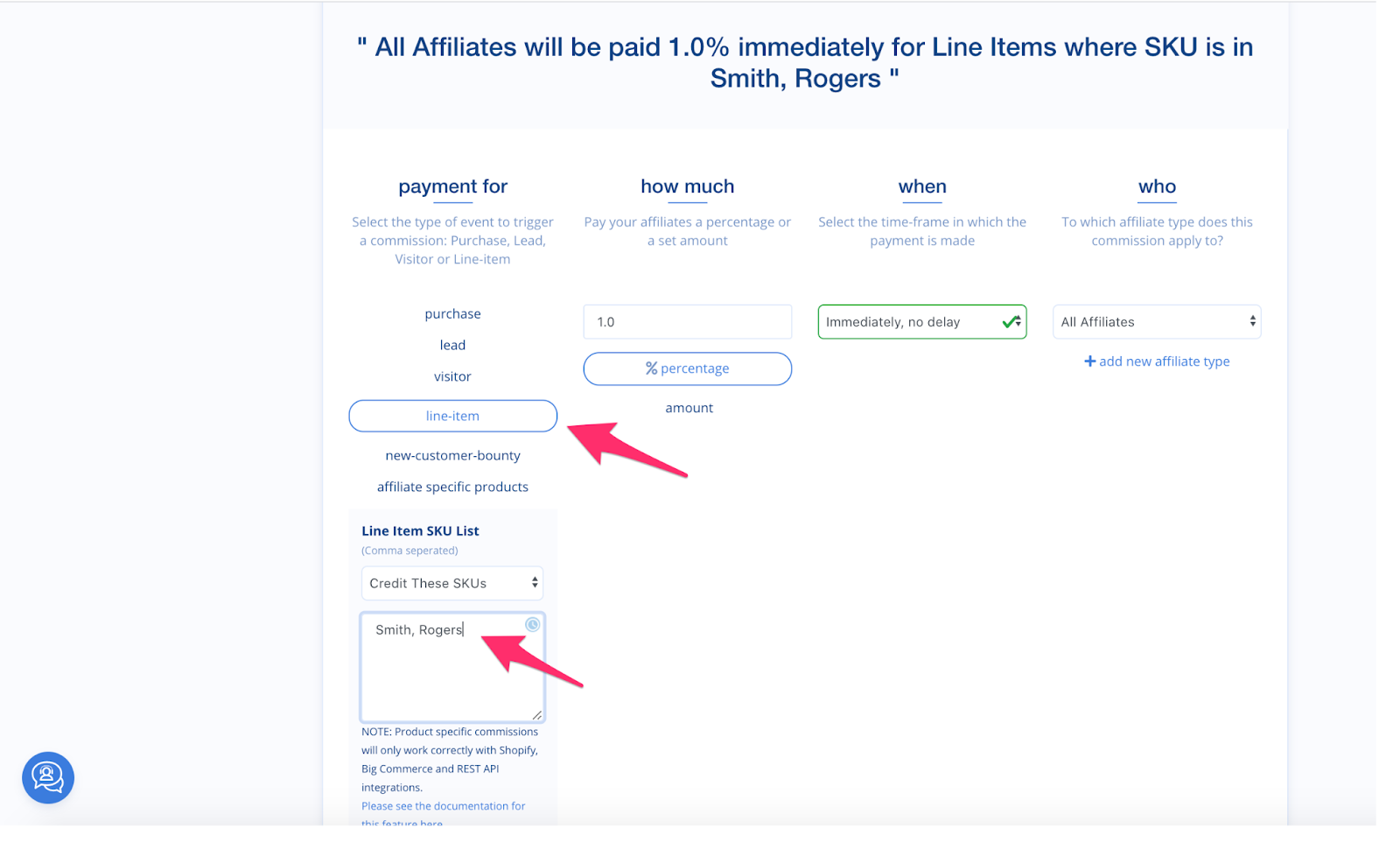
If your affiliate program only offers one commission tier, consider exploring ways to offer multiple tiers. Typically, this looks like having a tiered commission structure that rewards your best partners with higher rates for progressive sales milestones.
Test different commission levels to find the sweet spot where affiliates are motivated to promote while you maintain healthy margins. You might also experiment with performance bonuses for affiliates who exceed specific sales thresholds. This could look like:
- 0–10 sales/month → 7% commission
- 11–30 sales/month → 13% commission
- 31+ sales/month → 17% commission
The best way to do this is by using an affiliate tracking software like LeadDyno. You can easily set up tiered commissions or even per-product commissions.
#3: Improve affiliate onboarding and activation
Many affiliates join programs but never actually promote anything. The culprit? Poor onboarding. To combat this, we recommend providing ready-to-use creative assets, a clear getting-started guide, and a welcome email sequence that sets expectations and provides support.
Two actionable ways you can better onboard affiliates are:
- Send a welcome email within 24 hours of signup to introduce the program, set expectations, and give them one clear first action.
- Provide a ready-to-use marketing asset kit including social, email, website, and other materials that fully supports your affiliates' content marketing initiatives without creating something from scratch.
Software like LeadDyno can help you automate this process, while also providing an even better experience for your affiliates than a manual approach.
#4: Monitor and prune underperformers
Over time, you're bound to have to audit your affiliate roster to cut out underperformers that may not be sending qualified traffic or the desired actions you’re looking for. Sometimes, an affiliate will change their audience targeting over time, or they could have signed up with good intentions, but there is a mismatch. They might have even forgotten about your products or services and need to be re-engaged.
Don't be afraid to reach out to underperforming affiliates to understand the disconnect. Sometimes a simple conversation can reveal opportunities for improvement. If affiliates remain inactive despite outreach, consider pruning them from your program to focus resources on your top performers.
{{blog-cta}}
#5: Align landing pages with affiliate traffic
We highly recommend setting up the right landing pages to convert your affiliate traffic.
For example, let’s say you have an affiliate segment that is price-sensitive. Make sure the landing page that affiliates are sending traffic to leads with clear value propositions and pricing information.
Misaligned messaging between affiliate content and landing pages creates friction that could be limiting the ROI potential of your partnerships. For instance, we have seen brands that take affiliate marketing seriously (such as Synergy Science) set up dedicated landing pages specific to each partner to maximize the relevancy and relatability.
The best practice is to work with your top affiliates to understand their audience's needs and preferences, then create custom landing pages or promotional materials that resonate with those specific visitors.

#6 Build relationships with top affiliates
It’s important to establish deep relationships with your top affiliates (remember what we said about the Pareto principle?). They deserve more than automated emails and standard commissions.
Treat your top affiliates like strategic partners, not vendors. To do this, consider scheduling regular check-ins, asking for feedback, and involving them in product launches or special campaigns. These relationships can transform good affiliates into brand advocates who drive consistent, high-quality traffic.
How to track affiliate ROI properly
Now that you know how to calculate and improve your affiliate ROI, it’s time to properly track this KPI and metric on an ongoing basis.
The manual approach (and why it's painful)
Without dedicated affiliate software, tracking ROI means using spreadsheets, custom UTM links, and manual commission calculations. This can certainly work when you only have 1 or 2 affiliates. However, once your program expands beyond that, you’ll find yourself spending hours each week reconciling sales data, calculating commissions, and making sure payouts are aligned with the affiliates' expectations.
On top of that, your affiliates won’t have a dedicated dashboard that can provide them easy access to their performance metrics, marketing materials, affiliate links, and more. That means more manual work for you.
Beyond being incredibly time-consuming, doing things manually is also error-prone and susceptible to fraud. A single miscalculation can lead to incorrect payouts and frustrated affiliates. Plus, when you're buried in administrative tasks, you have less time to focus on strategic growth activities like recruiting high-quality affiliates or optimizing campaigns.
Clunky manual processes often lead to higher hidden costs over time. Unfortunately, these hidden costs like affiliate turnover, manual administrative work, and fixing errors can significantly deteriorate the ROI of your affiliate program overall.
How LeadDyno automates affiliate ROI tracking
Fortunately, you can automate these manual processes with software that can also calculate your affiliate ROI. Here’s how:
Automated profit and commission tracking
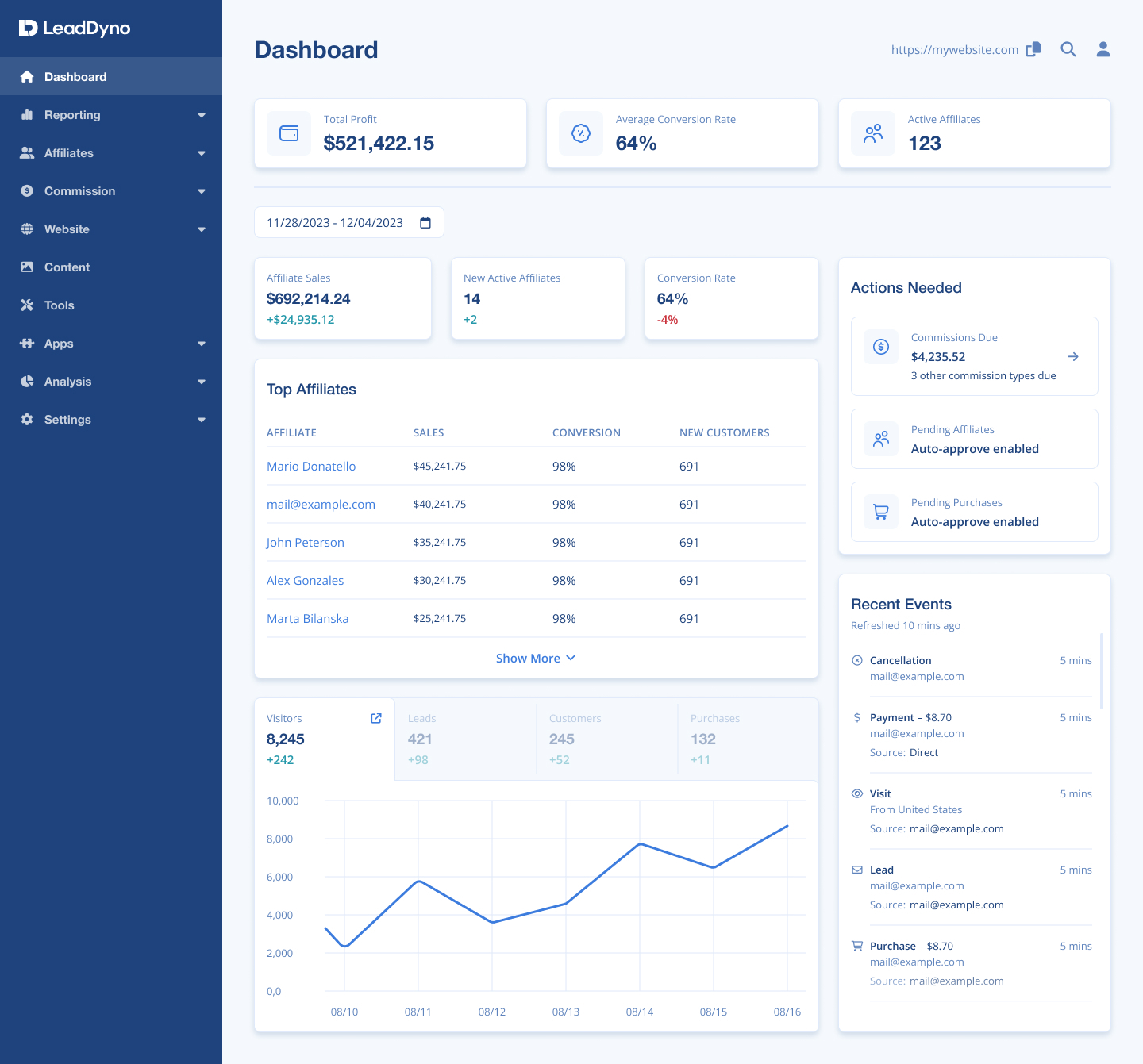
When you use software for your tracking, you can automate your ROI calculations right on the main dashboard. Every sale is automatically tied to the affiliate who drove it and is tracked in real time. Profit is then calculated as the total sales driven by affiliates, minus any commissions paid or due.
Affiliate onboarding made easy
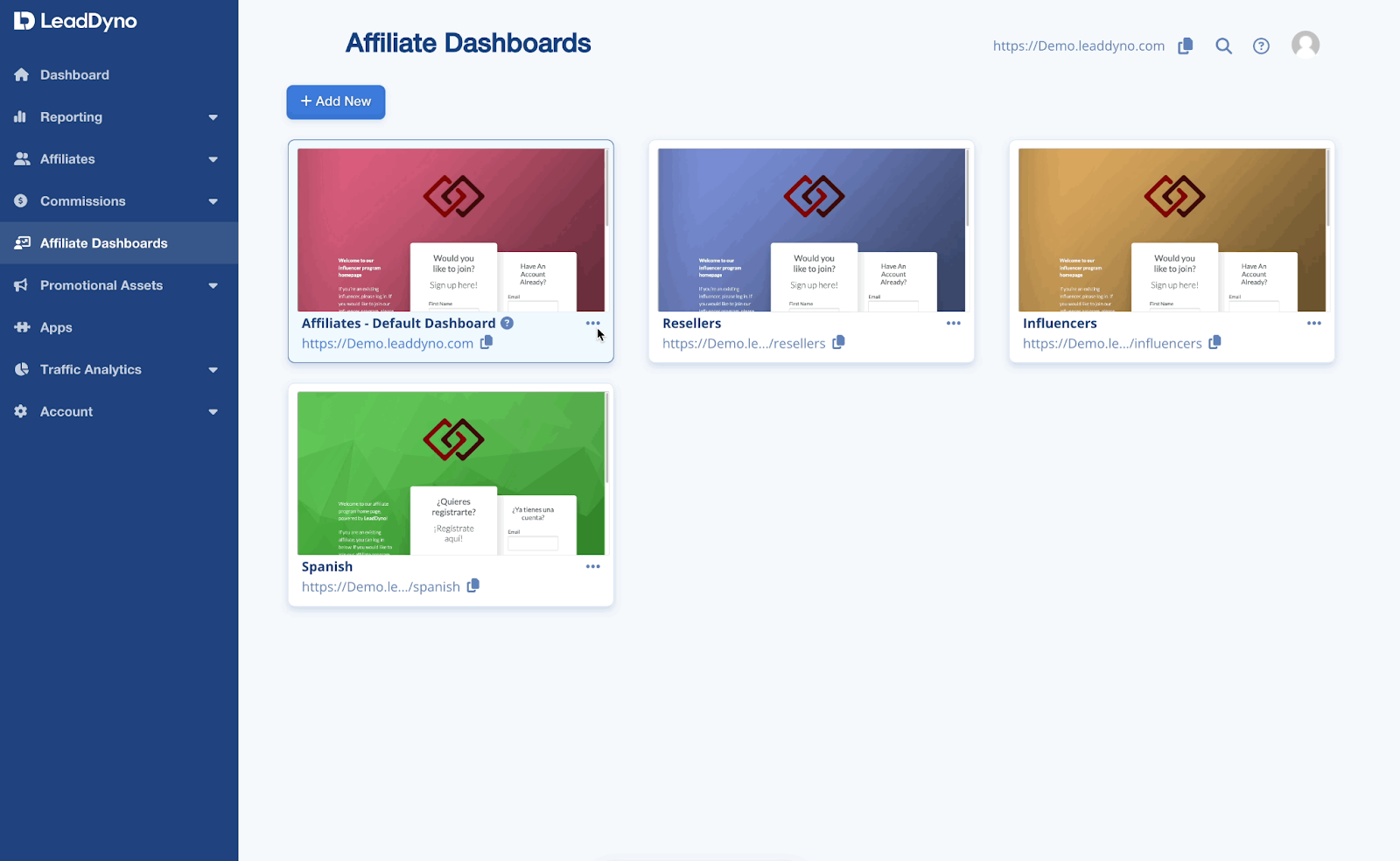
Affiliates can self-serve through their own dashboard, viewing their performance, accessing promotional materials, and tracking earnings without constant manager intervention. This reduces your workload while keeping affiliates engaged and informed.
In fact, you can even segment and customize your affiliate dashboards to best serve the different groups you onboard.
Relationship management tools
Built-in messaging, performance reports, and streamlined payout management reduce the time cost of running your program. You can communicate with your entire affiliate network or individual partners directly through the platform.
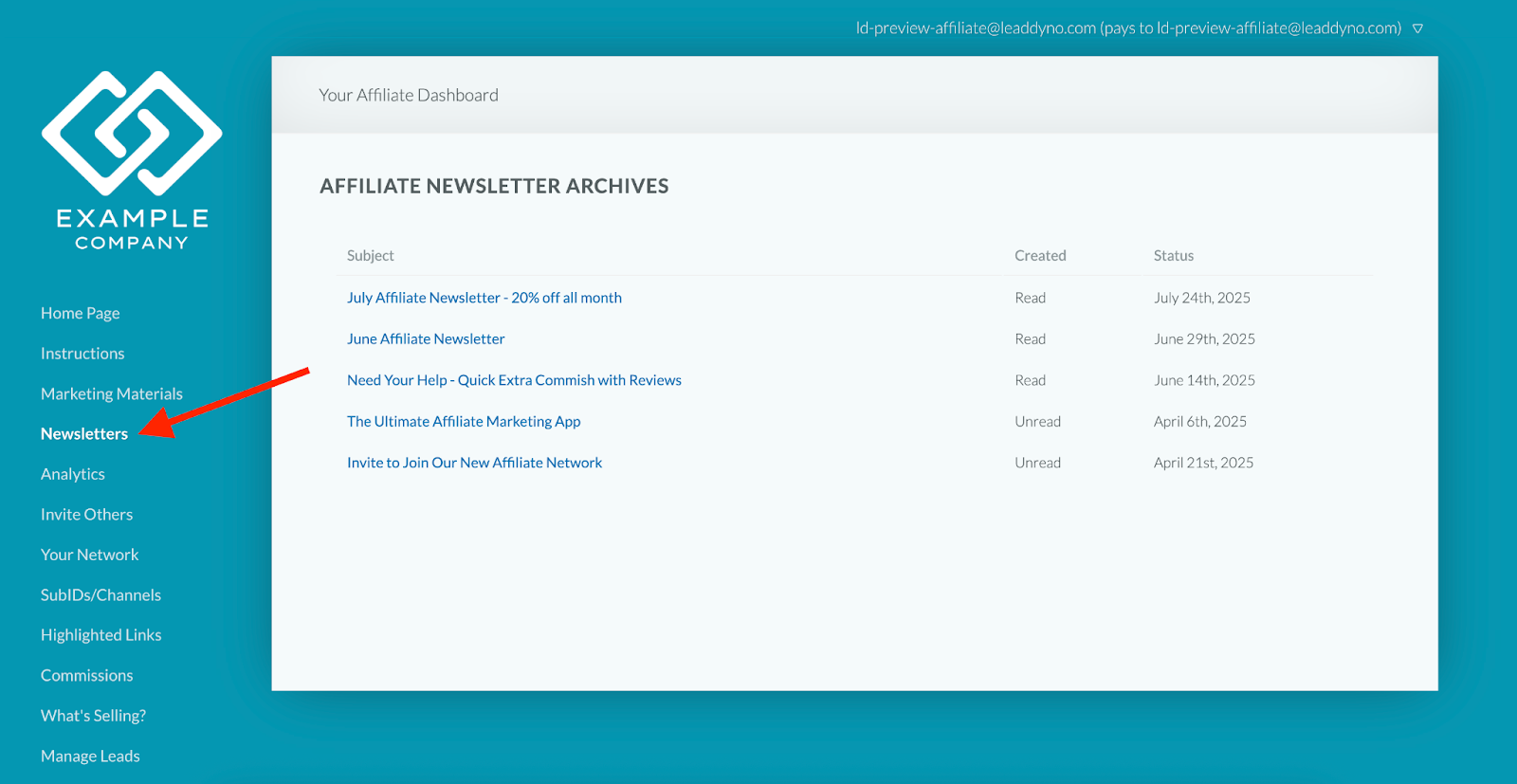
For example, you can easily send out newsletters to your affiliates for product updates, campaign communications, and other important information you want to share with your partners.
Overall visibility
See total program revenue versus costs in one centralized dashboard, making it simple to report results to executives and stakeholders. You'll always know exactly how your program is performing without digging through multiple systems.
The real value of automation extends beyond time savings. Reducing manual processes lowers your program's operating costs. And you'll see improved affiliate performance with better-managed, better-informed affiliates who receive timely payments and clear performance insights.
{{blog-cta}}
Final thoughts
The most successful affiliate programs aren't built on having the most partners. Rather than paying upfront for impressions or clicks with no guaranteed return, you only pay when a conversion actually happens. There's no wasted spend, no guessing on attribution, and no risk of pouring budget into campaigns that don't perform.
Start measuring, start optimizing, and watch your affiliate program become a powerful growth engine for your brand that can outperform other marketing channels.
Start your free trial today and see how LeadDyno can take your affiliate marketing strategy to the next level.
.webp)

.svg)
Start a Free Trial
30 days free · Full Access
Cancel anytime
You might also be interested in...



Get Started Today
Launch your affiliate program with confidence thanks to our 30-day free trial. Begin building a program that delivers results.

