
Affiliate Conversion Tracking 101: An Easy Guide for Newbies
See how LeadDyno can take your affiliate marketing strategy to the next level. Let’s set up a 1:1 demo to get your questions answered.
Affiliate conversion tracking is the process of measuring what happens after someone clicks an affiliate link. It shows whether that click leads to a signup, purchase, or other beneficial action. For affiliate marketing programs, conversion data is one of the most important performance indicators, because it helps identify which affiliate partners, campaigns, and traffic sources are the most successful.
Today we’ll be discussing the ins and outs of affiliate conversion tracking, including how to calculate and optimize your affiliate marketing conversion rates. Because this kind of data tracking plays an important part in the long-term success of your affiliate marketing program, we’ve made sure to include everything you need to know to be able to track conversions successfully.
Let’s get started!
Why is it so important to track conversion rates?
Conversions are the main objective of any affiliate marketing program. When you track affiliate marketing conversion rates, you learn three important things:
- How effective your ads and affiliate campaigns are
- Where you might be able to minimize costs
- Where you have opportunities to boost your revenue
Tracking these metrics gives you a clear view of what’s working and what should be tweaked for a better outcome. Without this specific information, it’s hard to know whether your affiliate marketing strategy is headed in the right direction. Accurate conversion data helps you make informed decisions, refine your approach, and build a stronger, more profitable affiliate program.
How does affiliate conversion tracking work?
Affiliate conversion tracking helps you link a click on an affiliate link to a completed action, like a purchase or signup. Whenever someone clicks an affiliate link, the tracking platform records details like the click ID and any subID parameters.
If that person later completes an action, the platform receives the conversion data through a tracking pixel, postback URL, or server-to-server tracking method. This information is then matched back to the original click.
Essentially, affiliate conversion tracking connects clicks to conversions. This makes it possible to measure attribution, calculate payouts and revenue, and see which affiliates, traffic sources, or campaigns give the strongest performance.
What are the primary methods for conversion tracking?
There are several ways to track affiliate conversions, and each works a little differently.
Tracking pixels
A tracking pixel is a small piece of code placed on a thank you or confirmation page. When the page loads, it sends basic details like the order ID and purchase amount back to your affiliate platform.
Postback URLs or server-to-server tracking
Instead of using the browser, this method sends conversion data directly from one system to another. It’s more reliable for cookieless environments and helps avoid issues like blocked scripts.
UTM parameters and first-party cookies
These help you determine where a visitor came from by storing information such as source and campaign name. They also keep attribution accurate when users return to your site later.
The best tracking method depends on your setup, how much data you need to capture, and how accurate your tracking needs to be.
Are click-through rates and conversion rates the same thing?
No, these two metrics serve different purposes for your affiliate program. However, both click-through rates and affiliate conversion rates help you understand what’s working and what’s not; they just do it in different ways.
Click-through rates (CTRs) measure interest. They display how many visitors clicked your ad to visit your website or landing page.
Conversion rates (CRs) measure results. They display how many websites or application visitors complete an action out of your total number of visitors.
Or to put it even more simply:
- CTRs answer: Did people click?
- Conversion rates answer: Did people take action?
CTRs help you understand your customer base and clarify what does or doesn’t work when trying to draw in your intended audience. Low CTRs may indicate you’re targeting the wrong audience or that you’re not engaging your audience enough to convince them to click on your advertisement.
High CTRs aren’t necessarily a positive sign. If your ads fail to target the correct keywords or if your website and marketing materials aren’t relevant enough, then your ad may end up being a waste of money in the long run. That’s why it’s important to test multiple elements for conversions.
Unlike CTRs, affiliate conversion rates help you measure the total success of your campaign. Again, conversions are the main objective of affiliate marketing. If visitors aren’t converting, you’re not running a successful campaign.
How do you calculate affiliate conversion rates?

While the average affiliate conversion rate can vary, most affiliate marketers aim for a conversion rate between 1 and 3%; in other words, for every 100 people who click on an affiliate link, 1-3 of them will end up making a purchase. The formula to measure affiliate marketing conversion rates changes depending on the type of conversions you’re measuring. It stays the same in structure, but the formula inputs change based on whether you’re tracking clicks, leads, or completed purchases.
To calculate the conversion rate for paid advertisements, take the number of conversions and divide by the number of total ad interactions tracked during the same period.
For example:
Let’s say you have 50 conversions from 1,000 interactions.
50/1000 = 5%
So your conversion rate is 5%.
To find out the conversion rate for users visiting your website who turn into leads, your formula would be:
(Total number of leads collected ÷ total site traffic) x 100
Another way to use conversion rates is to track how many website visitors convert into paying customers. Here’s that formula:
(Total number of sales ÷ total traffic to the site) x 100
Each of these formulas is useful depending on whether you’re measuring leads, sales, or overall campaign performance.
Tools for Tracking Affiliate Conversion Rates
Once you understand how to calculate conversion rates, the next step is to choose the right tools to track and analyze them. Here are two versatile tools for tracking affiliate conversion rates and click-through rates.
LeadDyno
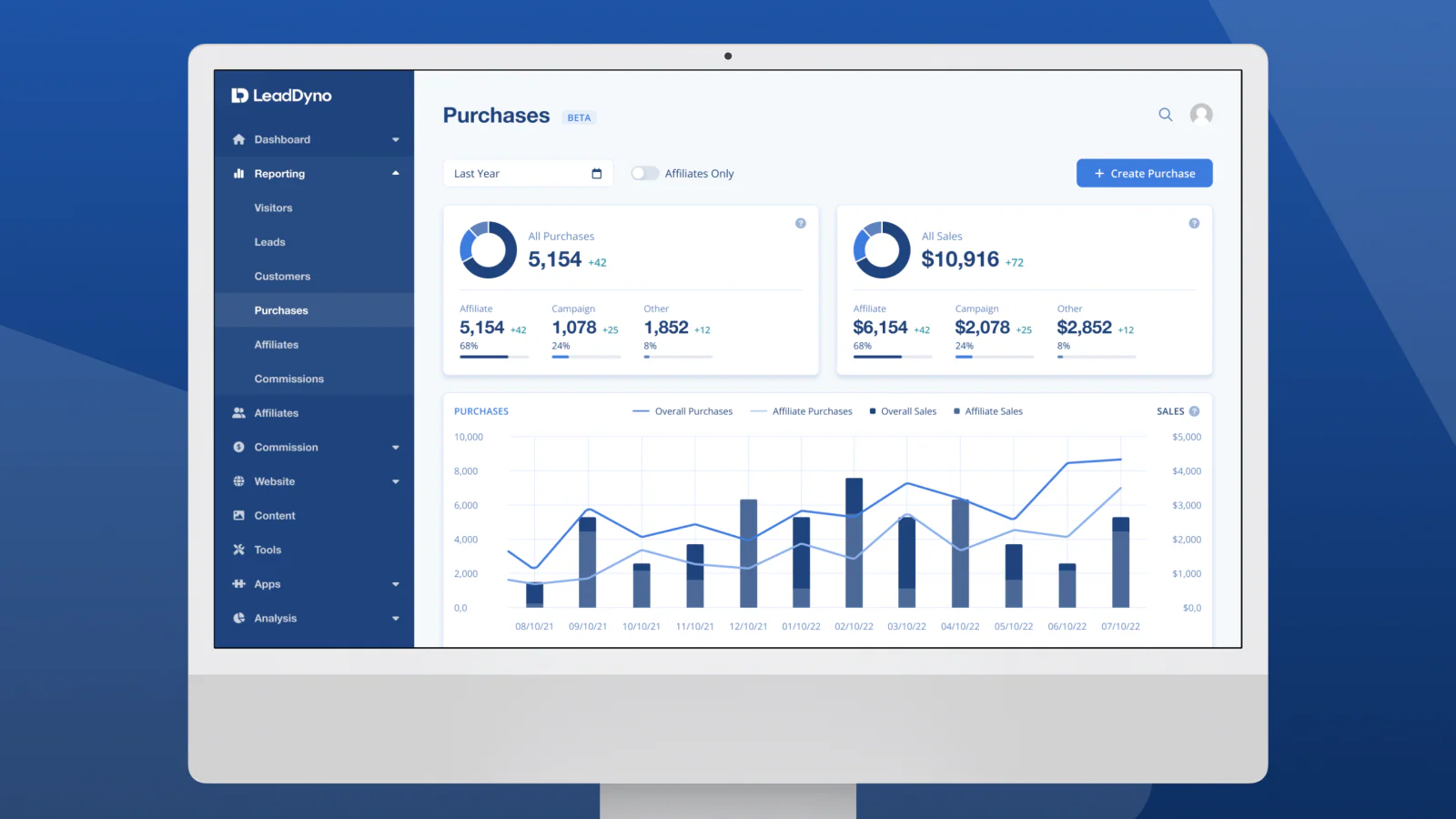
LeadDyno is an affiliate marketing platform designed specifically to track affiliate conversions, manage partners, and attribute commissions accurately. It allows you to create tracking campaigns across your online marketing channels to track clicks, leads, conversions, and cancellations tied directly to affiliate referrals.
When you create a tracking campaign in LeadDyno, you assign it a unique label and campaign code, then enter the URL you want to track. You can also group related campaigns using shared descriptions or group names, which makes it easier to compare performance across affiliates, channels, or promotions.
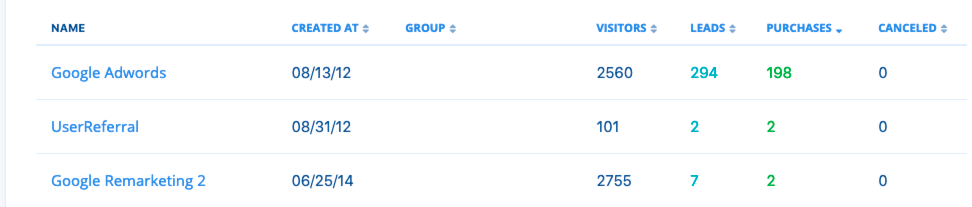
Once a user clicks an affiliate tracking link, LeadDyno records referral data and monitors actions such as visits, signups, purchases, and cancellations. This conversion data is automatically attributed to the correct affiliate, ensuring accurate commission tracking and payout calculations.
With LeadDyno, you can:
- Track affiliate clicks, leads, sales, and cancellations in one dashboard
- Attribute conversions to the correct affiliate using referral links and IDs
- Monitor affiliate performance by campaign, channel, or traffic source
- Manage commissions and payouts based on real conversion activity
{{blog-cta}}
Because LeadDyno combines affiliate conversion tracking with affiliate management tools, it gives program owners a clear view of which affiliates and campaigns are bringing in the most revenue. You can also use LeadDyno alongside Google Analytics 4, which helps you fill the gap between behavioral insights and affiliate-specific attribution. That way you can track results, reward affiliates accurately, and grow your program quickly.
Google Analytics
Google Analytics 4 is a powerful tool for tracking affiliate conversion activity and user behavior across websites and platforms. GA4 uses an event-based tracking model, which allows you to measure actions like affiliate link clicks, form submissions, purchases, and signups as conversion events.
GA4 helps you understand how users interact with your site before converting, including traffic source, device type, page engagement, and session paths. This makes it easier to determine which affiliate traffic ends in a desired action rather than a mere click.
With GA4, you can:
- Track affiliate link clicks as custom events
- Mark key actions as conversion events
- Analyze attribution across multiple traffic sources
- Measure performance even as browsers limit cookies
GA4 also supports cross-domain tracking and consent mode, which improves accuracy for affiliate programs operating across multiple domains or regions with privacy requirements.
For the best results, combine GA4 insights with your affiliate tracking software to get a clearer view of how traffic turns into conversions.
How to Optimize Your Affiliate Conversion Rates

If your affiliate conversion rates are lower than expected, conversion tracking can also help you determine where potential customers are dropping off. Low conversion rates are common in affiliate marketing and often indicate an issue somewhere between the initial click and the final action.
Improving affiliate conversion rates generally comes down to two approaches. You can either send more qualified traffic to your landing pages, or you can increase the likelihood that existing visitors complete the desired action. While many marketers focus on traffic volume, improving click-through behavior and on-site experience can be just as important for increasing conversions.
Below are some practical questions to ask yourself to help optimize affiliate conversion rates through better UX and stronger targeting.
1. Where are users dropping off before converting?
Before making changes, it helps to understand where conversions may be falling short. Affiliate conversion tracking allows you to compare how many people click an affiliate link with how many actually complete an action. If clicks are strong but conversions are low, the issue is often not traffic volume but what happens after visitors arrive.
For example, if users leave the landing page within seconds, the drop-off is likely happening immediately after arrival. In other cases, visitors may browse product pages or start a signup flow but abandon the process before the final step. Identifying where users exit the funnel helps you focus your optimization efforts on the stages that matter most.
2. Is your website optimized and loading properly?
According to Google, 53% of visitors will abandon a page if it takes more than 3 seconds to load. Slow load times can also lead to missed conversions when users leave before a tracked action has time to complete. Even a small delay can have a noticeable impact on conversion rates. It only takes one additional second of loading time for conversions to drop by 7%, repeatedly.
Faster load times improve user experience and decrease the likelihood that visitors will abandon your webpage before completing a tracked action. If your website feels slow, here are some of the things you can do to troubleshoot the issue:
- Run a site speed test to discover any performance issues.
- Review your hosting plan to make sure it provides enough resources for your traffic and usage. Shared hosting can limit performance, so upgrading to a virtual private server or managed hosting may help.
- Use performance optimization tools to find large files, slow scripts, or unnecessary requests.
- Check your website’s responsiveness across different devices and screen sizes.
- Use a content delivery network (CDN) to serve images and other assets from locations closer to your visitors.
- Audit installed plugins or extensions and remove any that are unused or unnecessary.
- Periodically clean up your database and review your codebase if performance issues persist.
Once you’ve completed these steps, monitor your conversion rates to see how performance improves.
3. Does your landing page match what visitors expect?
Even with a fast website, conversions can suffer if your landing page doesn’t fit user expectations. Affiliate traffic performs best when a page clearly showcases the message, product, or benefit that your affiliate is promoting.
If visitors click an affiliate link expecting one offer but end up on a page advertising something else, they’ll be less likely to convert. Reviewing conversion rates by traffic source can help you find any mismatches between affiliate messaging and landing page content so you can adjust accordingly.
4. Is your niche optimized?
If you’re running an affiliate program, chances are you already operate within a defined niche. That niche should be communicated clearly in your keywords, content, landing pages, and promotional channels.
To optimize your niche:
- Focus on keywords that match buyer intent
- Use keyword variations naturally across your site and content
- Target lower-competition terms that attract more qualified visitors
Tracking conversions by keyword or traffic source helps you focus on the audiences most likely to take action rather than those who simply browse. If you’ve never conducted keyword research before, you can start by using free tools like Google Keyword Planner, Keyword.io, or paid SEO keyword tools like Semrush and Ahrefs.
5. Are you creating high-quality content?
The quality of your content plays a major role in conversion performance. Your content should match search intent and answer real questions. This will help build trust and keep visitors engaged long enough to convert.
Rather than creating content just to publish, focus on evergreen material that will still be useful over time. Ask yourself what information your audience genuinely needs and how your content will help them come to a decision. Relevant, well-written content increases engagement and supports higher conversion rates by encouraging visitors to complete tracked actions.
6. Are you adding reviews to your website to build trust?
According to Clutch, 96% of consumers look at reviews before making a purchase. Reviews are a proven method of social proof in e-commerce affiliate marketing, quickly boosting brand credibility and minimizing potential buyer hesitation. Seeing real feedback from other customers helps visitors feel more confident about taking the next step.
Adding reviews to high-traffic landing pages can improve consumer trust, increasing conversions. Try comparing your conversion rates before and after adding testimonials to landing pages to measure their impact on your affiliate marketing strategy.
.webp)
7. Do you have a visible call to action on your website?
Are your call-to-action (CTA) buttons buried within your copy, or do you feature them clearly at the top of your page? If CTA buttons aren’t displayed in a prominent place, visitors may leave without converting. Call to actions should also be near the top of your content, so viewers don’t overlook them when scanning your webpage.
Effective CTAs:
- Use clear, action-oriented language
- Stand out visually from surrounding content
- Appear early on the page and remain easy to find
- Utilize active voice
- Create a sense of urgency without pressure
.webp)
It’s also helpful to use striking CTA button colors. When tested, orange, blue, red, and green appear to be the top-converting colors, but what was deemed more important was choosing a color that contrasts well with your site’s design. Above all, avoid camouflaging the button with the background of your website (e.g.,dark green button on a dark green background). Opt instead for eye-catching colors that fit your branding.
Tracking CTA clicks and completed conversions will help you determine which messages and placements perform best.
8. Do you A/B test your website to help boost conversions?
A/B testing, also known as split testing, is a marketing method used to compare two versions of a web page or application to see which performs better. There are several common testing approaches; the right one will depend on what you’re trying to optimize.
Traditional A/B testing presents users with two separate versions of the same page at the same URL, each with a single change. This method is great for testing one element at a time, like a headline or call to action.
Redirect or split testing sends users to different URLs that host separate versions of a page. This approach works well when testing entirely new page layouts or experiences.
Multivariate testing (MVT) measures how multiple changes on a single page work together. This method allows you to test combinations of elements like layout, text, and visual design at the same time.
For optimizing affiliate conversion rates, traditional A/B testing is usually the best place to start. Start with the original page, create a variation with one small change, and test both versions at the same time. Traffic should be split between the two versions, and the page with the higher conversion rate becomes your new baseline. You can then repeat the process by testing another small change.
Once you find out which version receives more clicks, signups, or purchases, you can continue refining your pages based on real user behavior.
Common areas to test include:
- Landing pages
- Traffic from paid advertisements
- Calls to action
- Page layouts and messaging
9. Are you promoting your products through multiple channels?
When you promote your products across an assortment of marketing channels, your brand connects with a variety of audiences in multiple ways, increasing your chance of being seen and gaining conversions. Cross-platform promotion is a great way to amplify your reach while still prioritizing your audience’s needs. But it’s important to adapt your message to each channel rather than simply copying and pasting the same content everywhere.
While Google discourages intentionally duplicated content across competing web pages, sharing adapted versions of your content across platforms is both acceptable and effective. Each platform serves a different purpose and attracts users with different expectations. For example, question-based platforms like Quora are useful for providing helpful answers and directing interested users to deeper resources. Video platforms like YouTube and TikTok work well for short, engaging explanations, while LinkedIn is better for industry insights and educational content. Just make sure that when you promote content across channels, you also adjust the format, tone, and depth to match the intent of each platform.
{{blog-cta}}
Conclusion
Conversion tracking and conversion rate analysis help you determine which affiliates, traffic sources, and landing pages lead to user actions rather than just clicks. With proper affiliate conversion tracking in place, tools like LeadDyno and Google Analytics make it easier to collect conversion data and measure important results in your affiliate marketing campaigns. Without these insights, it’s difficult to know what’s working, what needs improvement, and where to focus your optimization efforts.
By monitoring conversion rates and applying proven optimization strategies, you can improve attribution accuracy, increase conversions, and build a more effective affiliate marketing program over time.
.webp)

.svg)
Start a Free Trial
30 days free · Full Access
Cancel anytime
You might also be interested in...



Get Started Today
Launch your affiliate program with confidence thanks to our 30-day free trial. Begin building a program that delivers results.

