
[Guide] Multi-Tier Affiliate Programs: Setup & Strategy
See how LeadDyno can take your affiliate marketing strategy to the next level. Let’s set up a 1:1 demo to get your questions answered.
LeadDyno makes it easy to manage complex reward structures, referral chains, and payouts without manual tracking.
Your affiliate programs often reach a point where growth plateaus. As a result, revenue from this channel is hard to increase, which typically comes down to the structure of the program itself.
Multi-tier affiliate programs can be the solution to stalled growth. In a multi-tier structure, affiliates earn commissions on their direct referrals and the sales generated by the sub-affiliates they recruit.
By the end of this guide, you’ll understand how multi-tier programs work, if this structure is right for your business, and how to implement a multi-tier program to achieve meaningful growth. Let’s dive in.
How multi-tier programs level up your affiliate revenue
Transitioning to a multi-tier program introduces structural complexity, but the financial returns often justify the effort. Here’s how.
Understanding the tiers
The structure operates on distinct levels of attribution. Tier 1 refers to the direct commissions an affiliate earns when they personally generate a sale. Tier 2 and beyond represent the commissions earned when a recruited sub-affiliate successfully makes a sale.
Instead of having separate commissions for different products, multi-tier affiliate programs are a whole system designed to help you build revenue and grow your program.
For example:
- Tier 1: This is the standard, single-tier affiliate program that you already have set up. In this structure, you pay direct commissions to affiliates for the sales they make or the desired action they take. Very straightforward.
- Tier 2 (and others): These tiers represent the commissions earned when a sub-affiliate successfully makes a sale or performs the desired action.
Here’s how it works
Affiliate A recruits Affiliate B into the program. Affiliate B then generates a $1,000 sale, earning a 10% commission ($100). Because Affiliate A recruited Affiliate B, the program rules dictate that Affiliate A receives an additional $10 commission, or a 1% commission, on the same transaction.
Multiply your revenue, not your workload
Implementing multiple tiers creates a self-expanding network of affiliates. Your affiliate program will begin to grow as other affiliates recruit for you, while also driving sales — all without any additional upfront marketing expenditures. This is a huge benefit when compared to other channels and the associated upfront costs.
Who benefits most from a multi-tier model?
Typically, you’ll need a specific business model for multi-tier programs to work efficiently. These include businesses like:
- Multi-Level Marketing (MLM): This structure is the core of their business model.
- Software as a Service (SaaS): Companies with strong user communities can turn happy users into powerful referrers.
- E-commerce Brands: Loyal brand ambassadors can generate amazing returns with multi-tier setups.
The power of automation
Manually tracking multi-tier payouts is a recipe for disaster. An automated system tracks these relationships and calculates payouts accurately and effortlessly. LeadDyno can easily help you scale with multi-tier programs that support sophisticated affiliate and MLM programs.
Recommended Resource: Automate Affiliate Marketing for any Major CMS [How To]
How to set up a multi-tier affiliate program
Now that you know the positive impact multi-tier affiliate programs can have on your business and your bottom line, you’ll need to begin setting up your program with clear rules for commission distribution. It’s best to use software, like LeadDyno, so you can automate the process.
1. Set up your software to build sophisticated reward structures and tiers
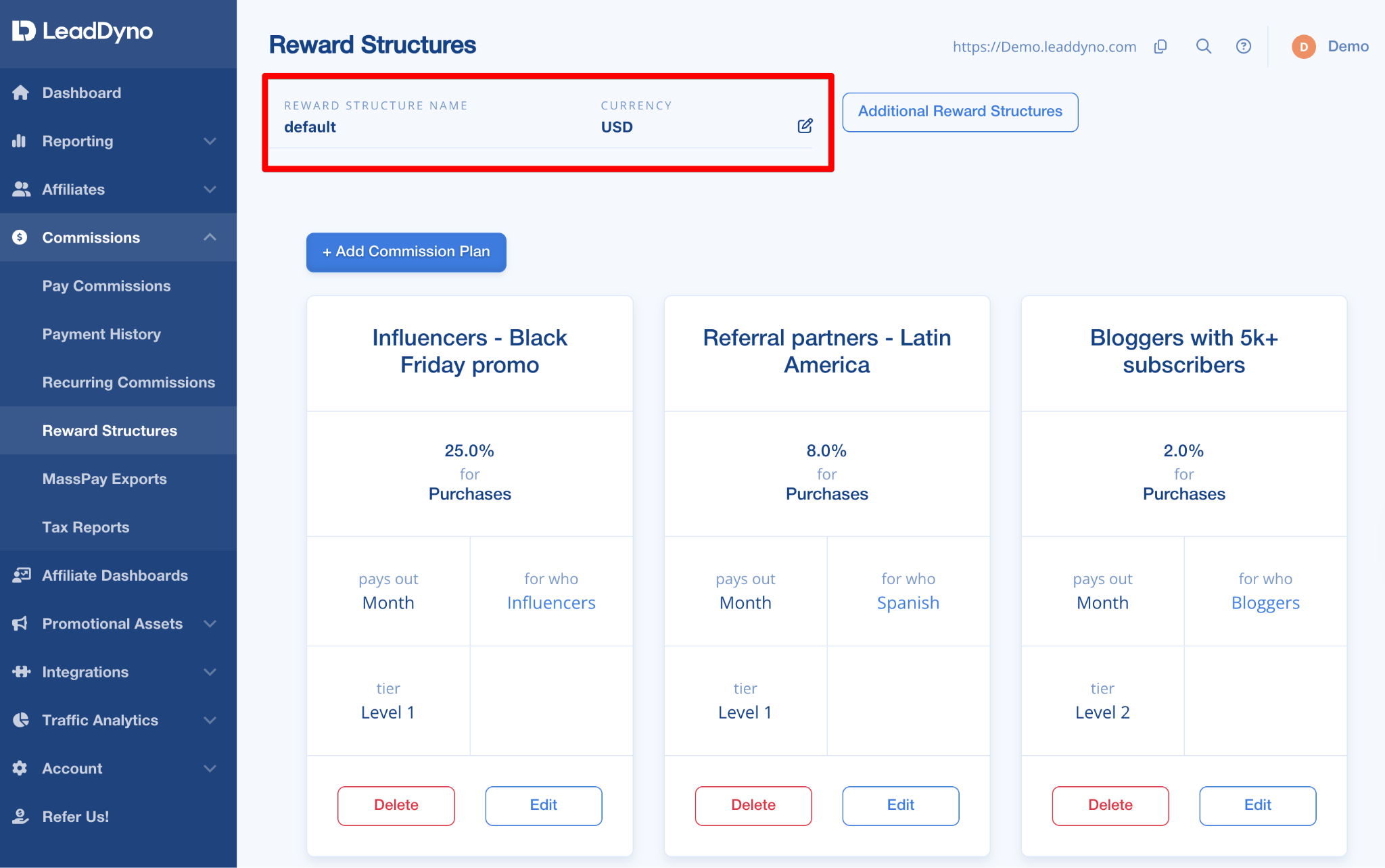
First, you’ll need to log in to your LeadDyno dashboard and navigate to the Reward Structures section. This area manages the specific commission structures that dictate affiliate compensation. From here, you’ll be able to create distinct plans for each tier in your program.
2. Define the tiers and commission rates
Now that you have your tiers and tracking properly set up, it’s time to do some financial analysis to find out how you can support commission payouts for several tiers. Most programs operate optimally with two to three tiers. With LeadDyno, you can set up to 10 commission levels.
For a standard three-tier setup, you will define the rates for the primary seller (Level 1) and their recruiters (Levels 2 and 3).
Level 1 Plan: Set the base commission (i.e., a 10% percentage payout) for the affiliate who directly sources the purchase.
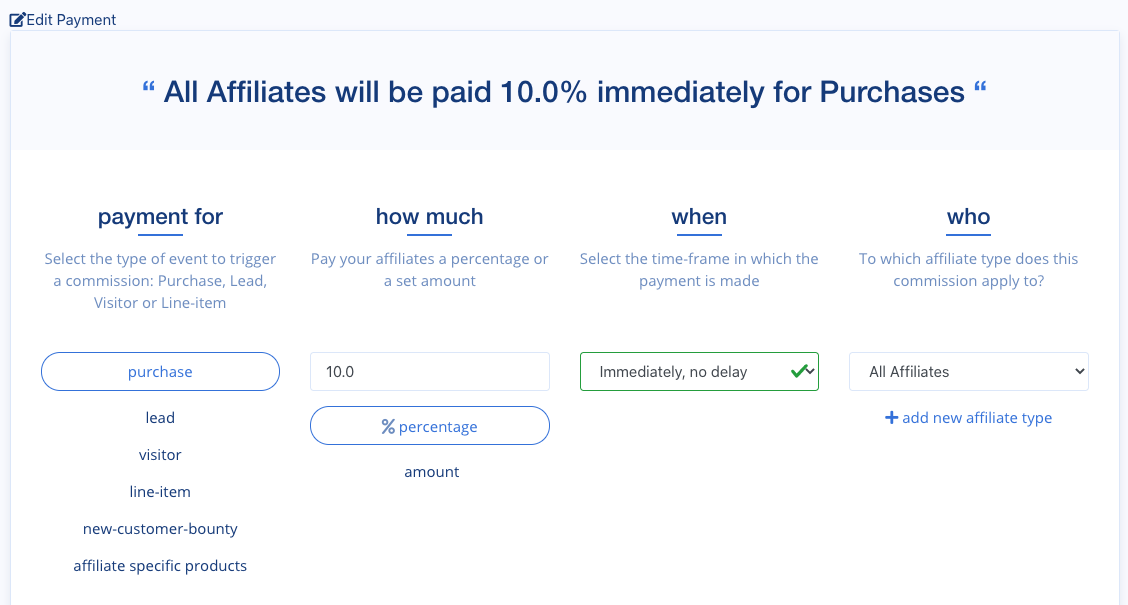
Level 2 Plan: Create a second plan targeting the "parent" affiliate. Set this commission at a lower rate, such as 5%. When the Level 1 affiliate secures a sale, the system attributes this 5% to the affiliate one level above them.
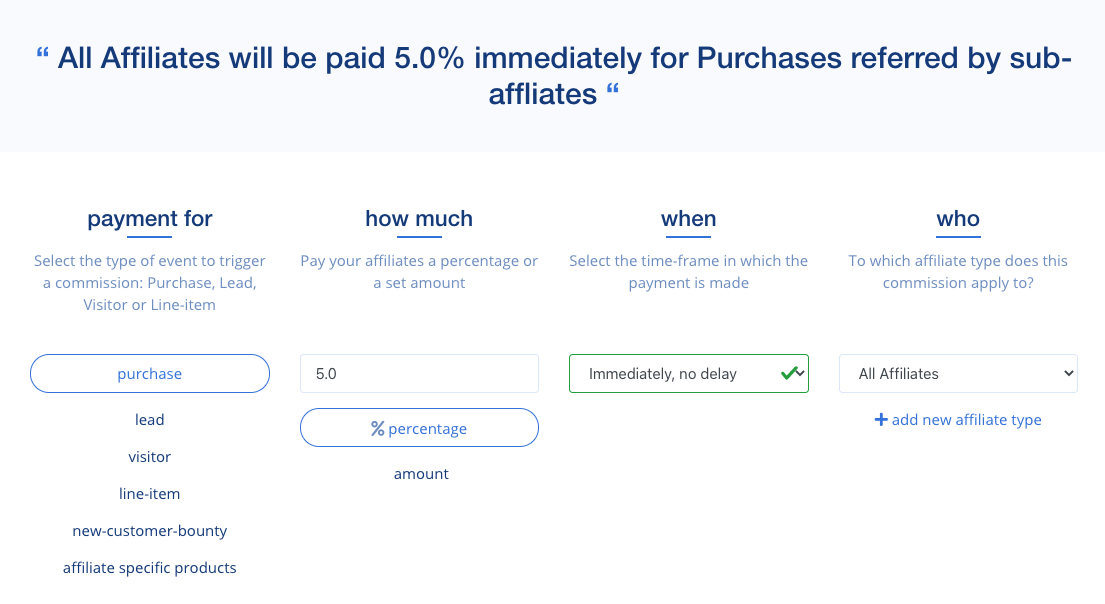
Level 3 Plan: If using a third tier, create a plan for the "grandparent" affiliate, setting the rate at 3%.
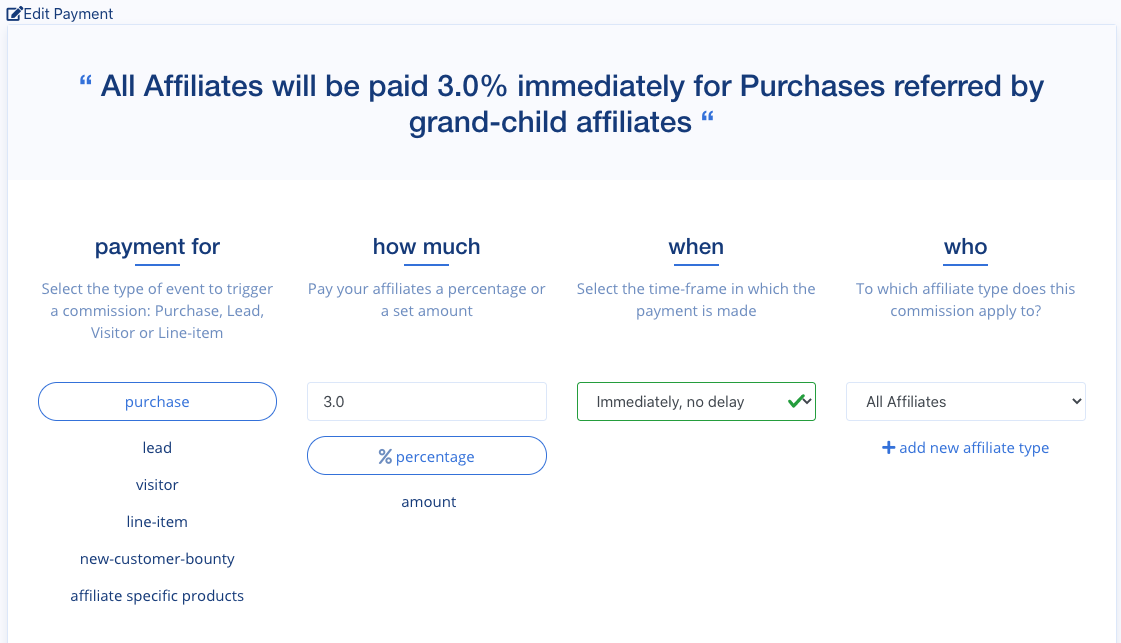
You can use flat-rate amounts or percentage-based structures depending on your product margins.
3. Enable affiliate invitation features
Once the heavy lifting of developing the tiers is complete, it’s time to make the network effect take shape – AKA your existing affiliates need an easy way to recruit others. To empower them and set them up for success, head over to your main Affiliate Dashboards settings.
From here, you’ll need to complete the setup for the email template that will go out to your desired list, which can be current customers or current affiliates.
When a new recruit clicks this unique link and registers, LeadDyno automatically links them as a child affiliate to the sender.
4. Configure referral links and network visibility
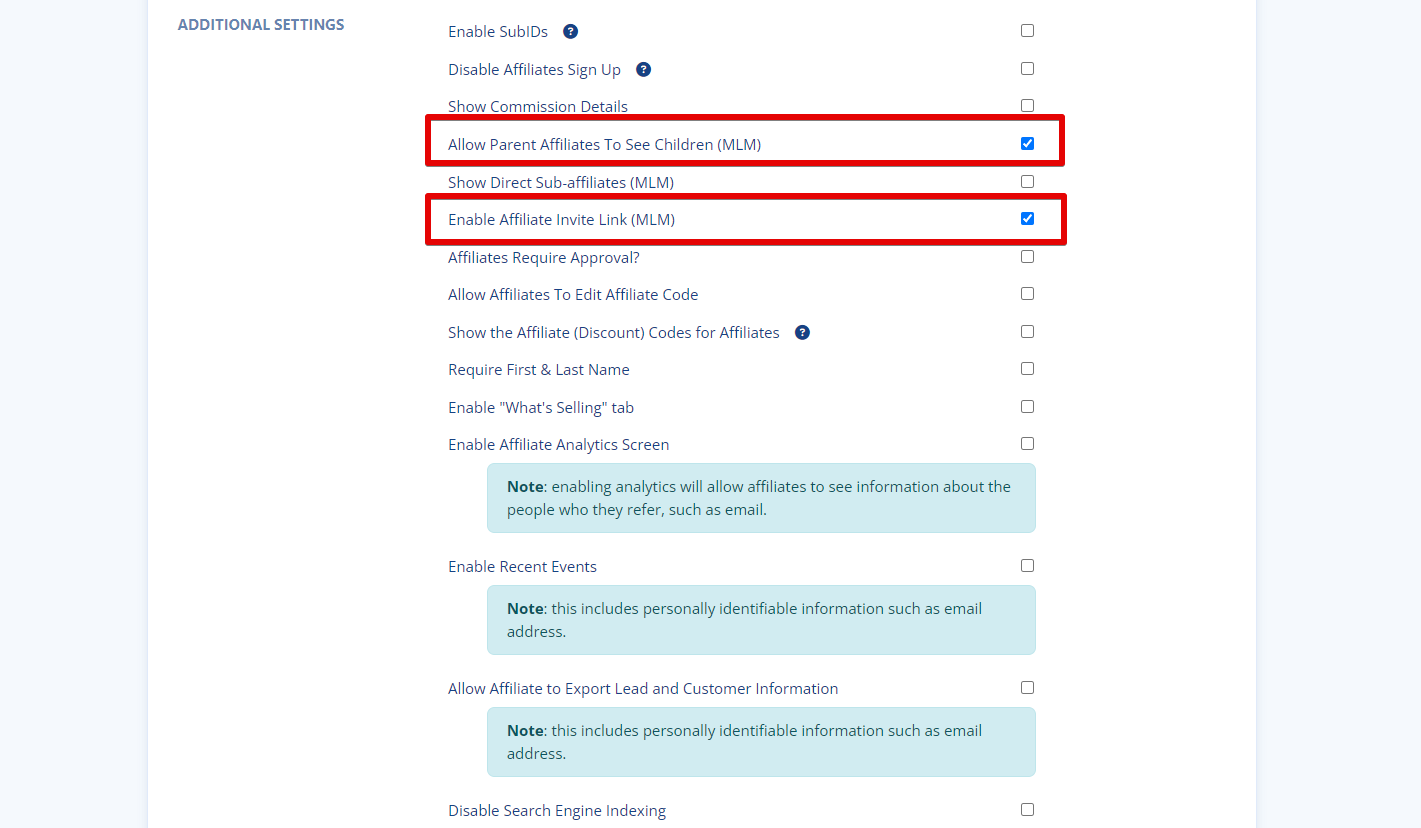
Next, it's time to enable advanced settings to help unlock more growth. In the Affiliate Dashboards settings, activate "Allow Parent Affiliates To See Children (MLM)" and "Enable Affiliate Invite Link (MLM)."
These settings provide affiliates with a shareable recruitment link and access to a "Your Network" page that shows the sub-affiliates they have successfully onboarded.
5. Test the referral chain
As with setting up any new program, you need to QC it. Before launching the program, create test affiliates (Affiliate A, B, and C) to simulate the recruitment chain. Then, process a test transaction through the Level 1 affiliate (Affiliate C) and verify in the dashboard that the correct commission percentages are distributed accurately to Affiliate C, Affiliate B, and Affiliate A.
Growing revenue from multi-level affiliate programs
Now that you have your multi-tier affiliate program in place, there are several other growth levers you can use to continue expansion.
Establishing the system architecture is only the first step. However, it’s active management that drives revenue. Apply these specific strategies to maximize the output of a multi-tier affiliate structure.
Gamify the recruitment process
Introduce structured incentives for recruitment. One of the best ways to do this simply is to build leaderboards and offer an additional one-time bonus to affiliates who bring in the most active Tier 2 recruits. This incentive could be a larger commission tier or even a car (maybe a Cybertruck) if you’re getting really creative.
Provide recruitment assets
Next, you want to do everything within your control to set current and new affiliates up for success. One way to accomplish this is to provide standardized materials that are easy to access and will assist their recruitment or sales efforts. Typically, this will include messaging materials, social media graphics, usable templates, and other marketing assets to explain the product positioning.
Continually optimize commission distribution
Even if you’ve carefully modeled out the commissions for each tier in the beginning, you’ll want to revisit and optimize these distributions across all tiers on a regular basis.
You can accomplish this by setting Tier 1 rates as competitive as possible, with the goal of attracting as many relevant affiliates as possible. Then, establish Tier 2 rates that provide sufficient financial incentive for layered recruitment and sales, without reducing your overall profitability.
You’ll need to continually analyze your margins to find the optimal distribution point. This sweet spot can also change over time as different parent-child affiliate chains grow.
{{blog-custom-cta}}
What to watch out for with your multi-tier programs
While a multi-tier affiliate program has many benefits, it also introduces specific operational risks you should be aware of.
Commission tracking errors
Attempting to track cascading commissions manually introduces a high probability of human error. Unfortunately, miscalculations can lead to inaccurate payouts and severe affiliate disputes.
That’s why we highly recommend implementing affiliate tracking software, such as LeadDyno, to automate this complex attribution process. The important part is to ensure that every level in the referral chain is credited accurately.
Fraud and abuse
Affiliate fraud is rampant, with nearly $3.4 billion in affiliate fraud happening annually. Multi-tier systems occasionally attract self-referral schemes or fraudulent accounts created solely to defraud your program and illegitimately gain additional secondary commissions. To prevent this, you need to implement specific payout conditions.
For instance, you can configure LeadDyno to require a minimum sales threshold or enforce a holding period before commissions become payable. This delay allows you to manually verify the legitimacy of the transactions and account for any refunded purchases.
Regulatory considerations
Multi-tier programs closely resemble multi-level marketing structures, which are subject to specific regional regulations. Programs with excessive tiers often attract regulatory scrutiny, so we recommend starting with a strict program with two or three tiers and consulting with legal counsel before aggressively expanding.
Final thoughts
By understanding the tier hierarchy, establishing precise commission plans, actively managing your network, and anticipating structural risks, organizations can build a sustainable, self-replicating revenue channel with a multi-tier affiliate program.
If you’re ready for your brand to unlock a new layer of affiliate revenue, start a free trial (free for 30 days) and see how LeadDyno can handle your multi-tier program needs.
.webp)

.svg)
Start a Free Trial
30 days free · Full Access
Cancel anytime
You might also be interested in...



Get Started Today
Launch your affiliate program with confidence thanks to our 30-day free trial. Begin building a program that delivers results.

