
Influencer Pricing 2026: How Much Do Influencers Charge by Platform, Tier, and Niche
See how LeadDyno can take your affiliate marketing strategy to the next level. Let’s set up a 1:1 demo to get your questions answered.
How much do influencers charge in 2026? The most accurate answer is: it depends.
There is no universal influencer rate card. Two creators with similar audiences can quote very different prices based on their engagement, niche, platform, content format, production requirements, and campaign terms.
For this guide, we cross-referenced that experience against current, widely-cited studies so the numbers below reflect current market consensus, not a single source's guess.
Why Influencer Pricing Varies So Much
Whether you've searched "influencer pricing," or "influencer rates," you've probably landed on the same problem: the ranges are wide enough to feel almost unusable.
This is due to an accurate reflection of an unregulated market.
Aspire's 2026 survey of roughly 1,200 creators put a real number on how wide that spread gets: among nano creators (1K–10K followers), the median Instagram Reel rate was $250, but individual quotes in the sample ranged from $10 to nearly $1,000, with the middle 50% of creators charging somewhere between $150 and $400. Two creators with identical follower counts can charge four times what the other does.
As Mauricio Abascal, managing director at talent agency Untitled Secret, put it to Shopify: "It's very arbitrary. It's not regulated. It makes it difficult, especially on the brand side."
On top of that, part of that unpredictability comes from treating "influencer" as a single job description when it's really an umbrella term for very different kinds of creators.
Audience size, region, and niche each move the number independently of one another — which is exactly why a single "influencer rate" doesn't really exist. The clearest way to budget is to work through those levers one at a time, starting with the one most brands reach for first: how big the audience actually is.
Beyond audience size, the same short list of real price drivers shows up across every source we reviewed, roughly in order of impact:
- Engagement rate, not reach. Saves and shares signal purchase intent far more than likes — a smaller, highly-engaged audience often outprices a bigger, passive one.
- Niche. Finance, B2B/SaaS, and health & wellness creators routinely charge multiples of general-lifestyle rates at the same follower count.
- Content format. A Reel or TikTok costs more than a carousel, which costs more than a static post or Story — exact multipliers further down.
- Usage rights and exclusivity. Reusing a post as a paid ad, or asking for a no-compete window, adds real cost on top of the quoted rate — covered when we get to how you should structure pay.
- Agency representation. Managed creators tend to charge more, often with another 10–20% in agency fees layered on top once an account crosses into macro territory.
The numbers below are directional benchmarks pulled from current 2026 data across multiple independent studies, not fixed price tags. Where two or more sources land in the same range, that's a stronger signal than any single number; where they diverge, we've flagged it. Treat all of it as a starting point to plan and negotiate from, not a rate card to quote back at a creator.
Influencer Rates by Follower Tier
Audience size is often the first lens brands use, so it’s a natural place to start.
Often referred to as influencer tiers, this framework distinguishes mega and macro influencers from micro and nano influencers by grouping them according to follower count, as shown in the infographic below.
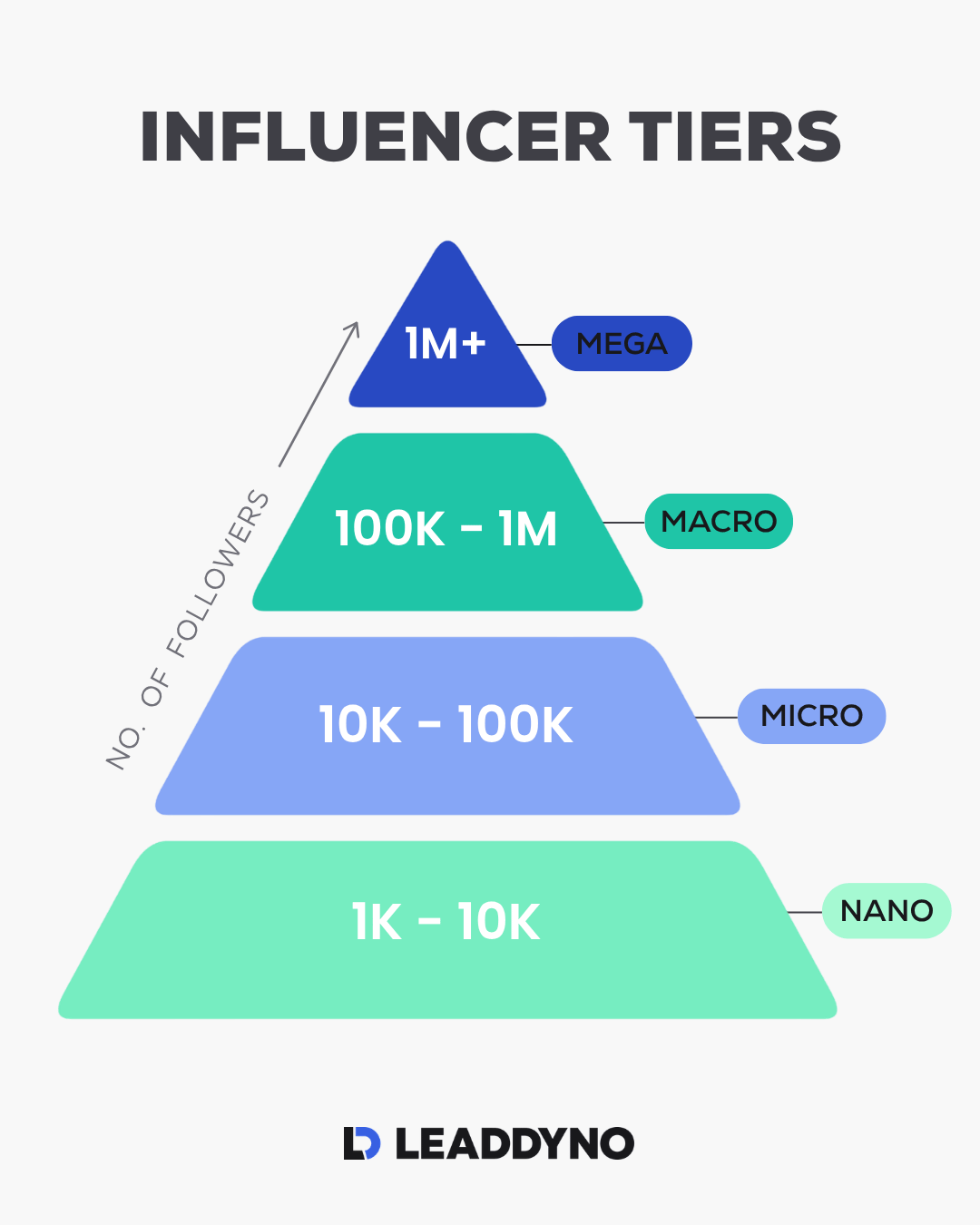
Rather than lean on one source's tier table, we pulled the nano-through-mega numbers from six independently published, current sources — Shopify, Influee, Later, Hootsuite, Modash, and Aspire's direct creator survey — and averaged the low and high end of each tier across every source that reported one.
These are rounded, cross-platform budgeting benchmarks. I calculated them from the lower and upper 2026 ranges reported for Instagram, TikTok, YouTube, and Facebook, rather than assigning one platform’s pricing to every creator.
A few quick takeaways from comparing the sources side by side:
- Two sources landed almost on top of each other. Shopify's and Influee's numbers matched closely across every tier — reassuring, though it likely reflects a shared underlying data aggregate rather than two fully independent measurements.
- Not every source draws the tier lines the same way. Later groups mid-tier and macro into one combined 100K–1M band, and Hootsuite splits "micro" at 50K instead of 100K, so those two sources' numbers are mapped to the closest matching tier rather than an exact fit.
- A couple of gaps were left as gaps, not guesses. Modash doesn't publish a nano rate, and Aspire's numbers past nano only exist as chart images we couldn't extract as text — both are simply excluded from those tiers' averages.
- The average holds up against real transaction data. Aspire's own surveyed nano median ($250 for an Instagram Reel) sits comfortably inside the computed ~$40–$370 nano range, which is a good sign the average isn't skewed.
Follower count is, by nearly every source's own admission, one of the weakest predictors of value on its own. A nano creator with 8,000 tightly-engaged followers in your exact niche will often outperform a much bigger account with a passive audience — and region matters just as much as size. A mid-tier creator whose audience sits mostly in a high-purchasing-power market can reasonably charge more than a same-sized account whose followers are spread thin across lower-spend regions.
Once you have a rough sense of the tier you're budgeting for, the next lever is where that creator actually posts, platform shifts the number just as much as audience size does.
Influencer Rates by Platform (2026)
Comparing different sources, these are the average rates that influencers charges based on the social media platform:
How the major platforms compare
Instagram: Offers the widest range of formats. Reels generally cost more than static posts or Stories because they require additional scripting, filming, and editing.
TikTok: Usually centers on one sponsored-video deliverable. Aspire’s creator survey found TikTok median rates were approximately 40% to 50% lower than Instagram Reel rates across most audience tiers.
YouTube: Typically has the highest production requirements. Pricing depends heavily on whether the brand buys a short mention, an integrated segment, a Short, or a dedicated video.
Facebook: Rates can vary widely, but the platform is less commonly used as a primary influencer channel than Instagram, TikTok, or YouTube.
X: Usually has lower production requirements and lower published rates. It may be most relevant for conversational campaigns in areas such as technology, business, finance, and news.
Platform is only part of the equation. The exact content requested can change the price again.
Influencer Rates by Content Format
Format matters almost as much as tier on every platform, though the pattern looks different depending on where the content lives.
In general, the more time, production, and creative work a format requires, the more it usually costs.
In general, content format pricing across platforms are:
Aspire found that static Instagram posts generally cost 50–60% of the equivalent Reel, while carousels cost approximately 25–33% more than static posts.
YouTube requires a separate comparison: Aspire found that integrated sponsorships generally cost 50–60% of a dedicated video, while dedicated videos start at a $700 median even among nano creators.
Shorts are priced more like Reels and TikTok videos than traditional YouTube content.
The creator’s industry can then move the price higher or lower, even when the audience size and format remain the same.
Influencer Rates by Niche
Niche shifts these numbers further. So now let’s explore these numbers based on niche.
Niche pricing is harder to express as one universal dollar amount because it interacts with platform, audience size, and content format. These relative multipliers are more useful for cross-platform budgeting.
Because available studies measure different platforms, formats, and creator sizes, the table below shows the latest published average, median, or estimated midpoint rather than combining incompatible figures into one misleading average.
Finance, B2B, and SaaS creators can charge more because they provide access to smaller but commercially valuable audiences. Influee reports that a micro creator in finance or SaaS may charge $500–$1,500 per Reel, compared with approximately $150–$500 for a similarly sized general-lifestyle creator.
Tier, platform, niche and format all shape the number, but none of them answer a more fundamental question: should you even be paying a flat rate at all?
Flat Fee vs. Commission-Based Pay
Did you know that a flat fee isn't your only option, and for a lot of brands, it isn't the best one?
The Hidden Cost of Flat-Fee Partnerships
With a flat-fee agreement, you pay the creator’s rate whether the content generates sales or not.
And the quoted rate is rarely the final cost. Common additional costs include:
- Usage rights
- Paid amplification or whitelisting
- Exclusivity
- Agency or management fees
- Rush delivery
- Additional revision rounds
- Travel, locations, props, or specialized production
- Product and shipping costs
Later recommends allocating approximately 50% to 60% of an influencer budget to creator fees, 20% to 30% to usage rights and amplification, 10% to 15% to platform or agency costs, and 5% to 10% as a contingency.
For example, a nano creator may quote $250 for an Instagram Reel. Once you add 90-day usage rights and 30 days of exclusivity, the final cost could rise to $400–$500.
You pay those costs whether the post performs well or generates no measurable results.
Commission-based pay reduces that risk. Instead of paying a guaranteed fee, the creator earns a percentage of the sales they generate. If the partnership does not convert, the brand’s cost stays low.
Commission-based partnerships
With commission-based compensation, the creator receives a percentage or fixed payment when a tracked action occurs, such as a sale, subscription, or qualified lead.
This reduces the brand’s upfront performance risk because more of the compensation is connected to measurable results.
Affiliate marketing continues to grow as brands look for more measurable creator partnerships. Global affiliate spend already reached $19.4B in 2026.
Long-term partnerships may perform better, too. Repeat YouTube collaborations can generate click-through rates up to 1.8 times higher by the eighth integration, while many customers need three or four exposures before purchasing.
Typical commission rates vary by industry, for example:
- Ecommerce: around 8–15% of each order
- SaaS: around 20–30% of recurring revenue
For brands with limited budgets, a practical approach is to start with commission-only or low-base-plus-commission partnerships. Use the results to identify top performers, then offer flat fees to creators who have already proven they can convert.
If you're new to how this works mechanically — unique tracking links, commission tiers, automated payouts — our affiliate marketing 101 guide walks through the fundamentals, and LeadDyno's own flexible commission plans (flat-fee, percentage, tiered, or recurring) are built to support exactly this kind of hybrid structure without spreadsheet gymnastics.
{{blog-cta}}
Influencer pricing FAQ
What determines influencer pricing?
Five factors, in order of real-world impact: engagement rate (not follower count), niche, content format, usage rights and exclusivity terms, and whether the creator is agency-represented. Follower count sets a rough ceiling, but it's one of the weakest predictors of what a fair rate actually looks like.
Is follower count the best way to judge an influencer's rate?
No. Multiple studies agree engagement rate, save/share behavior, and niche fit predict value better than raw follower count — and rates within a single tier can vary by 4x or more, per Aspire's direct creator survey. A cost-per-engagement calculation (rate ÷ average engagements) is a more useful filter.
Should I pay a flat fee or commission?
It depends on how proven the relationship is. New or unproven creators are lower-risk on a commission or hybrid (base + commission) structure. Flat fees make more sense once a creator has a track record of converting for your specific product — and industry data shows creators and brands are both moving toward hybrid models as trust builds over repeat collaborations.
Find your next affiliate program
.webp)

.svg)
Start a Free Trial
30 days free · Full Access
Cancel anytime
You might also be interested in...


Get Started Today
Launch your affiliate program with confidence thanks to our 30-day free trial. Begin building a program that delivers results.

