
How to Find Your Competitors' Affiliates (And Win Them Over)
.png)
See how LeadDyno can take your affiliate marketing strategy to the next level. Let’s set up a 1:1 demo to get your questions answered.
One of the best places to start when it comes to finding affiliates to recruit is by analyzing your competitors and their affiliate programs.
According to Forrestor and Rakuten, a massive 80% of brands currently run affiliate programs. That means there is a high chance that your competitors already have a list of affiliates who could promote your product too, without the hard work of building these lists on your own.
By the end of this guide, you’ll have an actionable plan you can begin implementing to recruit your competitors’ affiliates and begin generating sales through your affiliate marketing efforts. Let’s jump right in.
Why starting with your competitors makes sense
Firstly, finding competitor affiliates can save you countless hours of manual outreach and relationship development from people who may not be familiar with your product, service, or industry as a whole.
Competitor affiliates are basically pre-qualified and ready to begin selling as they’ve already shown a clear commitment to promoting similar categories to their audiences.
You can easily study what commission structures work
Not only does it help with pre-qualifying affiliates, but you can also easily conduct program market research by using this method too.
An important piece of research to gather is the commission structures and aligned incentives. If your commission rates aren’t competitive, it’ll be difficult to win over your competitors’ affiliates, as most are profit-oriented.
Recommended Resource: The Ultimate Guide to Affiliate Commission Rates
The step-by-step process for finding your competitors' affiliates
Here’s an actionable and step-by-step guide to finding your competitors' affiliates, today!
1. Make a list of your top competitors with affiliate programs
Start by identifying 5 to 10 direct competitors who currently run active affiliate programs.
Begin with confirmation
Confirm they have a program by running quick searches. Type queries in Google like:
- “[Brand] affiliate program,”
- “[Brand] partner program.”
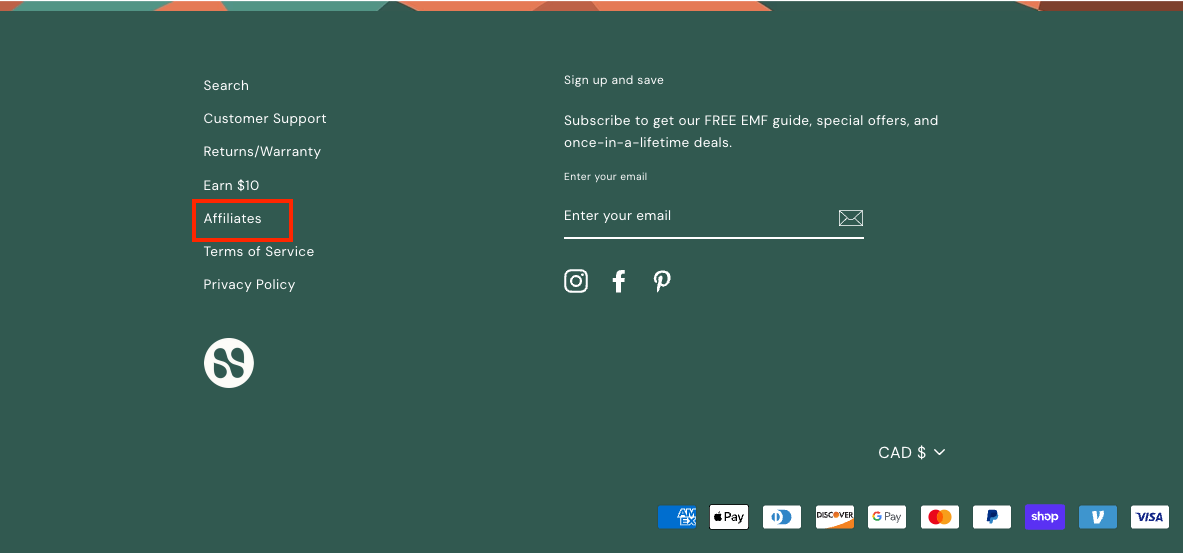
Another great place to start is by checking the website footer of the competitors you’re analyzing. It’s typical to have an “Affiliate Program” or “Partnership Program” link within the website’s footer.
Track with a simple spreadsheet
When it comes to tracking, don’t make things complicated. We recommend using a simple Excel or Google Sheet that tracks your research.
Create columns for
- The competitors’ names,
- The affiliate network they use,
- Their public commission rate, cookie duration, and
- Any notable perks they offer.
For prioritization, the brands that have the largest programs or that have the affiliates you see as potentially the most impactful are where you want to start. Or, if you’re looking for a more sophisticated approach, you can use tools like SEMrush or Ahrefs to find competitors with the most organic search traffic, and prioritize your list from there.

2. Use a basic search across popular platforms
Now that you have the list of your top competitors, links to their affiliate programs, and how you want to prioritize finding their affiliates, it’s time to use some advanced search techniques to help you find these types of affiliates and people.
Search specific operators on Google
Begin by using specific Google search operators. Try searching terms like:
- “[BRAND] coupon code,”
- “[BRAND] review,”
- “[BRAND] promo code,” or
- “[BRAND] vs [Your Brand].”
Filter YouTube results by “This year.”
YouTube is the 2nd most popular search engine now, and you can easily find affiliates there. On YouTube, filter your search results by “This year” to find currently active affiliates.
Look for channels with 5K–500K subscribers, as these mid-tier creators often deliver much higher conversion rates than mega-influencers, like your Kim Kardashians of the affiliate world.
Pro Tip: Take note of the specific URL structure in their video descriptions. Affiliate links almost always contain tracking parameters like ?ref=, ?aff=, /go/, or /recommends/.
TikTok & Instagram
After YouTube, social channels like TikTok and Instagram offer huge opportunities for finding competitor affiliates.
Begin by searching the competitors’ brand name combined with #ad, #sponsored, or #affiliate.

From there, sort by "Recent" to filter out inactive creators. On Instagram, you can also head over to your competitors' accounts, check the tagged photos, and find affiliates who are promoting the brand that way.
Pro Tip: Open a creator's bio link (usually a Linktree or similar), affiliates often stack multiple program links there, which tells you exactly who they're already working with.
Facebook Groups
Next, head over to the relevant Facebook Groups. They're a fantastic place to find dedicated affiliates, and they are becoming even more popular with recent Google updates.
Begin by searching niche groups where your competitors’ products could be discussed. You can easily find high-converting groups that can be a gold mine for finding the right affiliates who love to promote your products and services.
Reddit & Forum Communities
Reddit is another rich source, depending on your business and industry, as it’s grown significantly in popularity over the past decade.
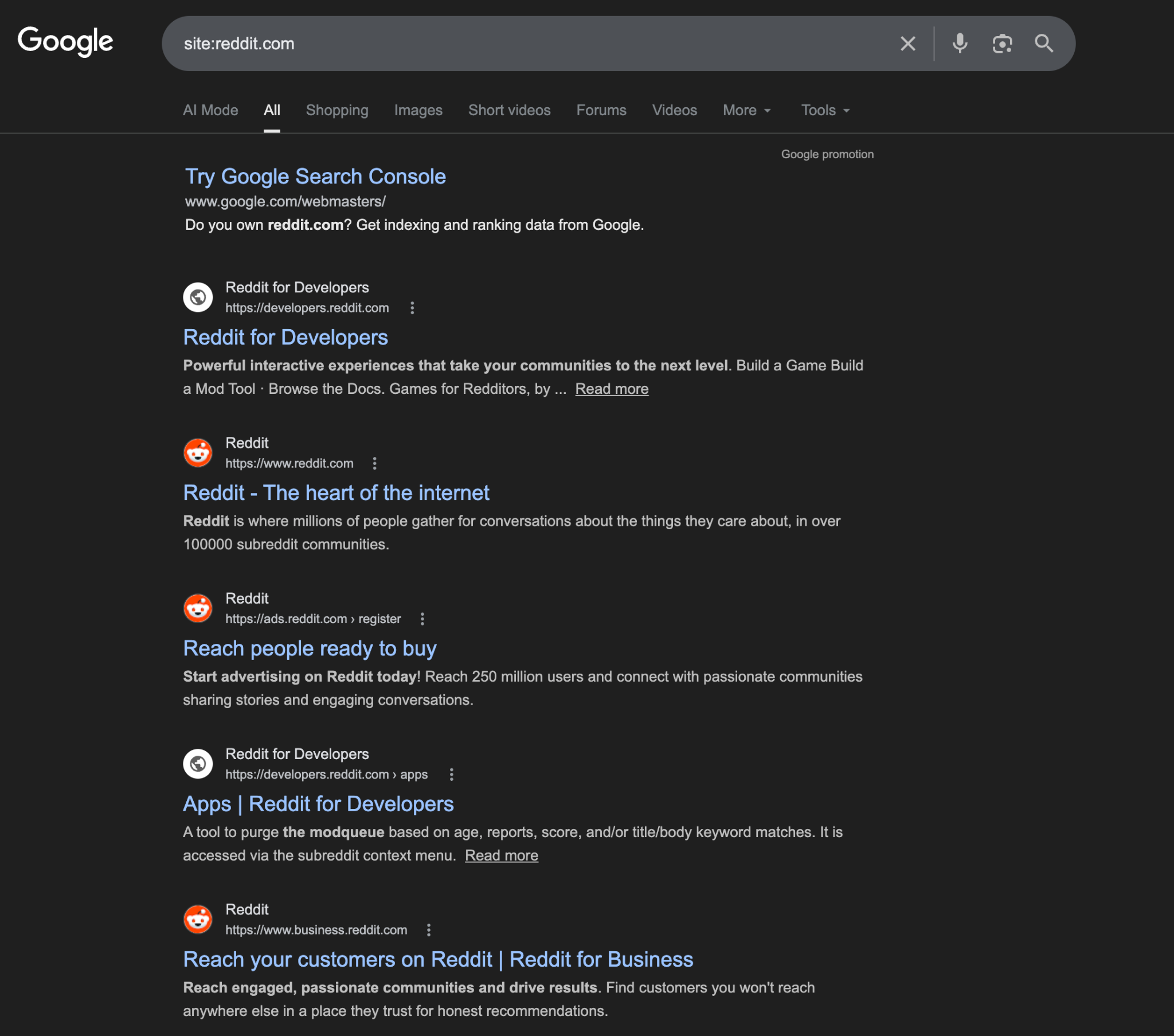
Begin by searching "[Competitor] review" or "[Competitor] discount" directly on Reddit, and filter by "Top (past year)" to surface active threads. Or, use Google for a site search using “site:reddit.com”.
This search could look like:
- “site:reddit.com highly recommended [PRODUCT NAME]”
- “site:reddit.com [PRODUCT NAME] Discount code”
- “site:reddit.com [INDUSTRY] + [PRODUCT OR SERVICE]
Find newsletters
Newsletter affiliates are especially undervalued. Tools like SparkToro and Who Sponsors Stuff can surface newsletters that have featured your competitor, and many of those operators run their own affiliate stacks that rarely get approached by direct competitors.
Use AI tools with deep research capabilities
Lastly, with the proliferation of AI tools, it can certainly help your affiliate competitor research speed up and make it easier.
With your favorite AI tool try using these sample prompt templates to get started quickly:
- “List the top 20 affiliate marketers and content creators who promote [Competitor Brand] in the [niche] space. Include their platform, audience size, and content type.”
- “What affiliate networks does [Competitor] use? What is their estimated commission rate and cookie window?”
Keep in mind, there are some heavy hallucinations that still happen with these tools, and they can lead you down the wrong path if you’re not fact-checking and reviewing the information provided.
Recommended Resource: Measuring Affiliate Marketing Program ROI [Guide]
3. Use tools to analyze online links and presence
While step 2 is amazing for finding competitor affiliates using free online search options and forums like Reddit, there are advanced tools that can help you pull much more extensive data, so you can scale the lists of competitor affiliates you’re able to build.
Ahrefs / SEMrush
Ahrefs and SEMrush are the most thorough options for backlink-based affiliate discovery.
The core workflow you can follow for either SEMrush or Ahrefs:
1. Open Site Explorer (Ahrefs) or Backlink Analytics (SEMrush)
Paste your competitors’ root domain in the respective section.
2. Go to Referring Domains
Next, in order to surface relevant domains, apply three filters in this order:
- Dofollow links only,
- Domain Rating (Ahrefs) or Authority Score (SEMrush) between 10 and 75, and
- Language matching your target market.
3. Sort by "Traffic" descending
Once you have this filtered list, you can sort by the sites and domains with the most organic search traffic. This prioritization will give you the best exposure with a new affiliate relationship.
4. Run a second pass on anchor text
Under the Anchors report, filter for anchor text containing the competitor brand name plus terms like "review," "discount," "coupon," "vs," or "alternative."
5. Export everything and dedupe
Finally, export your refined list and usually end up with a shortlist of 50–200 qualified domains to work through.
SpyFu
SpyFu is another amazing competitor analysis tool that’s specifically used for PPC intelligence data. This tool works well with e-commerce companies, as affiliates may run special discounts and codes through PPC.
If a small domain is bidding on branded keywords like "[Competitor] discount code" or "[Competitor] coupon," there is a high chance that an affiliate is running paid search as a promotional channel.
SimilarWeb
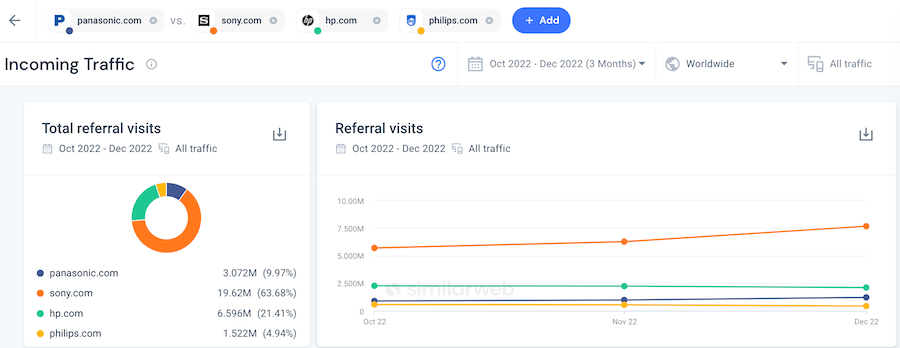
Another great tool is SimilarWeb. You can analyze competitors and identify their top referring domains, which can be strong indicators of potential affiliates sending relevant referral traffic via affiliate links.
4. Identify your competitors’ URL patterns and go deeper
Now, after using the advanced search tools in step 3, you’ll have a relevant list with potential links that affiliates use to promote your competitors. Understanding how affiliate links are structured will help you spot them and find even more affiliates from your competitors.
Common affiliate URL patterns include:
- /go/
- /recommends/
- /out/
- ?ref=
- ?aff_id=
- ?via=
Testing the links
To test this, copy a suspected affiliate link and paste it into your browser. If it redirects to the competitors’ sites with a tracking suffix attached, you’ve most likely found an affiliate link or a link used to track sales and activity from an influencer.
In Ahrefs, search your competitors’ domains and filter their backlinks by URLs containing these specific patterns. This refinement allows you to surface affiliate publishers at scale.
Recommended Resource: Building an Affiliate Funnel That Drives Revenue for Your Company
5. Work with an affiliate management company
If you lack in-house resources, teaming up with experts can help you run these unique analysis steps. These support programs help your brand by providing affiliate management experts to develop better relationships and automate your affiliate programs.
If you'd rather have a dedicated team handle everything for you, LeadDyno is here to help. Our affiliate marketing management services help you cover recruitment, onboarding, reporting, and optimizations in between.
6. Develop a positioning strategy for your affiliate program
Finally, it’s time to combine all your competitor research and develop your unique program's positioning, so you can use it to convince competitor affiliates to promote your brand exclusively.
Before any outreach goes out, define your competitive advantages
Get another Excel or Google Sheet going and begin defining your distinct competitive advantages against each competitor. Almost like a SWOT analysis.
This could be higher commissions, a longer cookie window, better creative support, exclusive discounts, or tiered commissions that incentivize long-term relationships.
Once that analysis is done, it’s time to create a one-pager for your pitch. We also recommend including your commission rate, cookie duration, average order value, conversion rate, payout schedule, and support contacts. Give them the full picture so they can feel like they’re entering a more transparent and fruitful relationship.
Personalize every outreach email
Once the positioning is done, it’s time to get to outreach. The key is to personalize your outreach for every affiliate.
A framework you can follow includes: Acknowledge their great content, state your value proposition, highlight your differentiator, and end with a soft call-to-action like “open to a quick chat?”
Recommended Resource: Affiliate Policy Compliance & Rules Monitoring Guide for Brands
Final thoughts
Now that you have an actionable and step-by-step guide, put this to use and begin finding valuable competitor affiliates that’ll be willing to sell your services or products.
Once you find them, it’ll be important that you keep these new affiliates motivated and build the right infrastructure, using affiliate marketing software like LeadDyno to facilitate onboarding, dashboards, affiliate links, and more.
Start your free trial today, and automate your affiliate program with the right tools that’ll help you scale.
.webp)

.svg)
Start a Free Trial
30 days free · Full Access
Cancel anytime
You might also be interested in...



Get Started Today
Launch your affiliate program with confidence thanks to our 30-day free trial. Begin building a program that delivers results.

