
Affiliate Marketing 101: What It Is, How It Works, and Why It Matters
See how LeadDyno can take your affiliate marketing strategy to the next level. Let’s set up a 1:1 demo to get your questions answered.
LeadDyno handles tracking, commissions, affiliate onboarding, and payouts — so you can focus on growing partnerships, not managing spreadsheets. Join 2,000+ brands already running programs on LeadDyno.
Think about the last thing you bought online. Did you click a random banner ad, or did you buy it because a creator, YouTuber, or blogger genuinely recommended it?
If you chose the recommendation, you’re part of a massive consumer shift. People have developed blind spots for traditional ads, but they do trust other people and that trust has turned affiliate marketing into a $19.4 billion powerhouse used by many brands to fuel their growth.
But it’s not just trust making this channel explode; it's the financial model. At its core, affiliate marketing is a performance-based partnership where you only pay when a recommendation turns into a real sale. This makes it an incredibly low-risk way for brands to diversify their traffic and beat spiking ad costs.
Whether you are an e-commerce store looking to boost sales or a SaaS company aiming for qualified leads, this guide will break down exactly how that engine works, who is involved, and the step-by-step process to build your own program from scratch.
What Is Affiliate Marketing?
Affiliate marketing is a performance-based partnership model where a brand (the merchant) pays external partners (affiliates) a commission for driving specific actions — typically sales, signups, or leads — through the affiliate's unique tracking link.
The core idea: you share revenue with people who drive real results. Affiliates promote your products through their content, audience, and channels. When someone from their audience converts, the affiliate earns a commission. You only pay when it works.
This makes affiliate marketing fundamentally different from sponsorships or display advertising, where you pay for impressions or placements whether or not anyone buys.
In the coming years, over 90% of online businesses are expected to have a formal affiliate program in place. Why? Because partnering with people who already have your target audience's attention is incredibly profitable.
The Four Players in Every Affiliate Program
Understanding affiliate marketing starts with knowing who's involved. Every program has the same four key participants:
1. The Merchant (that's you)
Also called the advertiser or brand. You create the product or service, set commission rates, provide promotional materials, and pay affiliates for successful referrals. Your goals: reach new audiences cost-effectively and pay only for measurable results.
2. The Affiliate
Also called a publisher or partner. Affiliates promote your product to their audience in exchange for a commission. They might be bloggers, YouTubers, email newsletter writers, coupon sites, influencers, loyalty programs, or even other businesses. Their goals: earn passive or active income by promoting products they trust (or that convert well).
3. The Customer
The end buyer who clicks an affiliate's link and completes a purchase or other action. They may or may not know they're interacting with an affiliate link — and in most cases, their price is the same as if they went directly to you.
4. The Affiliate Platform or Network
The software layer that tracks clicks, attributes conversions to the right affiliate, manages commissions, and handles payouts. Some brands join established affiliate networks (like ShareASale or CJ Affiliate) that aggregate affiliates; others use dedicated affiliate management software like LeadDyno to run their program directly. The platform is the operational backbone that makes accurate tracking and fair payments possible.
How Does Affiliate Marketing Work? (Step by Step)
The mechanics are straightforward. Here's what happens from first click to paid commission:
- You set up your program. You define your commission rates, cookie duration, promotional rules, and creative assets, then configure tracking through your affiliate platform.
- Affiliates join your program. They apply or are invited, get approved, and receive their unique tracking links — one per affiliate, often one per campaign or product.
- Affiliates promote your products. They embed their tracking links in blog posts, YouTube descriptions, social bios, emails, or paid traffic. When a reader clicks, a cookie is stored in their browser.
- A customer clicks and converts. The customer lands on your site. If they complete the target action (purchase, signup, form fill) within the cookie window, the conversion is attributed to that affiliate.
- The platform records the referral. Your affiliate tracking software logs the click, the conversion, the order value, and the commission owed.
- You review and pay. After a validation window (to account for returns or chargebacks), you pay affiliates their commissions — via PayPal, bank transfer, or other payment methods your platform supports.
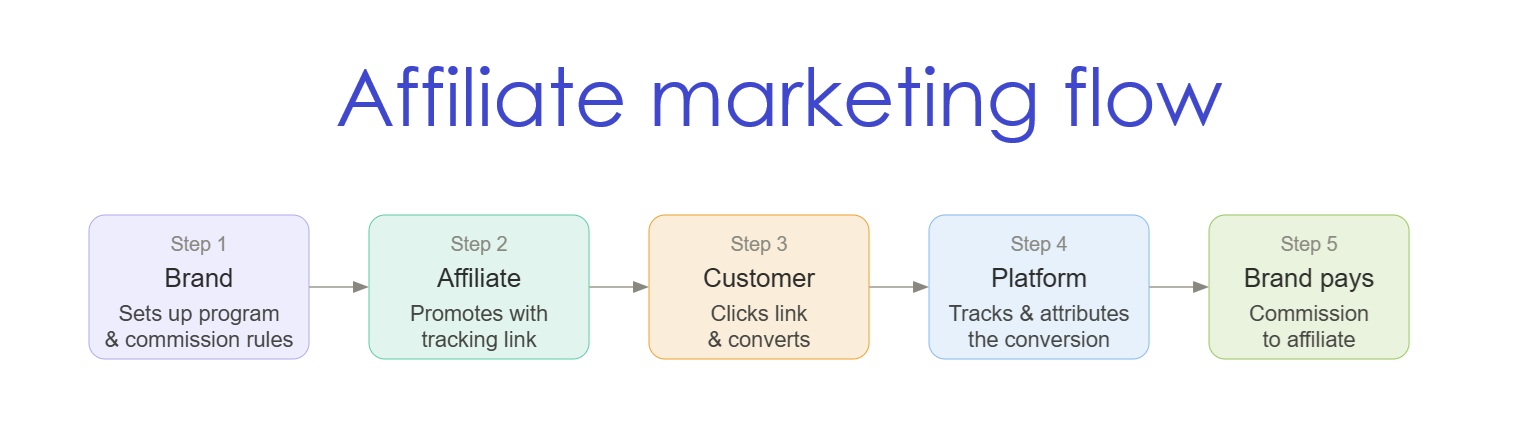
The tracking link is the linchpin. Without accurate attribution, you can't pay affiliates correctly, can't spot your best partners, and can't optimize what's working. This is why choosing the right affiliate platform matters enormously — we cover this in detail in our guide on tracking affiliate sales for brands.
Types of Affiliates: Who Promotes Your Products?
"Affiliate" is a broad category. The partners in your program might look very different from each other, and that's a strength — diversification reduces risk and expands reach. Here are the most common affiliate types:
Content creators and bloggers
Writers and publishers who create in-depth reviews, comparison articles, or how-to guides. Often the highest-intent traffic because readers are actively researching before buying. Best for brands with longer consideration cycles.
Influencers and social media creators
Instagram, TikTok, YouTube, or Twitch personalities with engaged audiences. Range from mega-influencers (millions of followers) to micro-influencers (a few thousand) — micro-influencers often drive higher conversion rates due to audience trust. Works especially well for visual or lifestyle products.
Email newsletter publishers
Writers with dedicated subscriber lists who recommend products directly to their inbox. High engagement, high trust, and often strong conversion rates because subscribers opted in specifically for that person's recommendations.
Coupon and deal sites
Platforms where shoppers actively look for discounts. Can drive volume at lower margins — valuable for clearing inventory or reaching price-sensitive buyers, but requires careful commission and discount management.
Loyalty and cashback programs
Sites that share a portion of their affiliate commission with members as cashback. Drives repeat purchases and attracts cost-conscious buyers.
Brand ambassadors and existing customers
Your happiest customers, community members, or industry peers who genuinely use and love your product. Often the most authentic promoters. If you're wondering how to find these people, our guide on finding competitors' affiliates includes tactics for identifying and recruiting quality partners.
B2B referral partners
In SaaS and professional services, strategic partners — complementary tools, agencies, consultants — who refer clients are a powerful (and underused) affiliate category.
How to Start Affiliate Marketing
Step 1 — Define your program details
Before you touch any software, you need to build your affiliate program strategy and make three decisions: how you'll pay affiliates, who your ideal affiliate looks like, and what the rules of your program are.
For commissions, decide on your structure (percentage of sale, flat fee, recurring revenue share, or tiered) and your rate. It needs to be competitive enough to attract quality partners and sustainable against your margins — research what brands in your category offer, because affiliates compare programs.
For your affiliate profile, think about who you want promoting your product. Content creators? Influencers? Industry peers? Existing customers? Getting specific here shapes every recruitment decision you'll make later.
For program rules, decide on your cookie window (30 days is the most common), which products are eligible for commission, whether affiliates can run paid ads using your brand name, and how you'll handle disputes. Sorting this upfront prevents headaches at scale.
Step 2 — Set up your program
With your decisions made, it's time to build. Choose an affiliate marketing software and connect it to your website or e-commerce stack — this is what generates unique tracking links per affiliate, attributes conversions accurately, and calculates commissions automatically. Without solid tracking, you can't pay affiliates correctly or identify what's working.
From there, configure your commission structure inside the platform, set up your payout schedule and payment methods (PayPal, bank transfer, etc.), and build your affiliate-facing program page — this is the page partners land on when they apply or are invited. Upload your creative assets here too: banners, product images, approved copy, and your brand guidelines.
{{blog-cta}}
Step 3 — Recruit and onboard your first partners
Start closer than you think. Your best first affiliates are often existing customers who love your product, creators already writing or talking about your category, and contacts in your professional network. A small group of genuinely aligned affiliates will outperform a large passive roster every time.
When they join, don't just send a tracking link and disappear. Give new affiliates a proper welcome: their unique link, ready-to-use creative assets, key selling points, commission details, payout timeline, and a direct contact for questions. Affiliates who feel supported promote consistently — ones left to figure it out go quiet.
Step 4 — Track and optimize
Once traffic starts flowing, look beyond clicks and commissions. Which affiliates are driving customers with the highest lifetime value? Which audiences convert at a higher rate? Where are the gaps — categories or segments you're not reaching?
Use that data to recruit more selectively, increase commissions for top performers, and cut or coach underperforming partners. The programs that grow fastest treat optimization as a continuous habit, not a quarterly review.
For a complete walkthrough — including how to write your program agreement, set cookie windows, handle fraud, and scale from your first 10 affiliates to 100 — see our full guide on how to start an affiliate program.
Why Brands Choose Affiliate Marketing
Affiliate marketing isn't just popular, it's structurally advantageous compared to most other channels. There are many benefits, including:
- You only pay for results. Every dollar in commissions corresponds to a real conversion. Compare this to display ads, where you pay for impressions whether or not anyone buys.
- It scales without proportional cost increases. More affiliates promoting your product doesn't require proportionally more spend upfront — it scales through performance.
- Affiliates bring built-in trust. A recommendation from a trusted creator carries far more weight than an ad. You access audiences that would otherwise be expensive or impossible to reach.
- It diversifies your acquisition mix. SEO dips, paid CPMs spike, algorithm changes hit — affiliate programs give you a channel that doesn't live or die by any one platform's decisions.
- Attribution is measurable. Unlike PR or brand awareness campaigns, affiliate marketing gives you clear data: which affiliate drove which sale, at what cost, with what ROI.
To see this in action across verticals, our affiliate marketing examples guide breaks down real programs across e-commerce, SaaS, services, and more.
Affiliate Marketing vs. Other Partnership Models
It's worth clarifying where affiliate marketing sits relative to similar concepts:
Many brands run both affiliate and referral programs simultaneously — they serve different purposes and different audiences.
Frequently Asked Questions
How much does it cost to start an affiliate program?
The main costs are your affiliate platform subscription and the commissions you pay. Commission rates typically range from 5–30% depending on your category and margins. Because you only pay on results, startup costs are low relative to most acquisition channels.
How long does it take to see results from affiliate marketing?
Most programs see initial traction within 30–90 days if they launch with a handful of active, relevant affiliates. Building a program that drives significant revenue typically takes 6–12 months of consistent affiliate recruitment and activation.
What's a typical cookie duration?
30 days is the most common window. Some programs use 7 days (for high-frequency purchase categories) or 90 days (for high-consideration, longer sales cycles). Longer cookies reward affiliates for upper-funnel influence; shorter cookies tighten attribution.
Do affiliates need to disclose that they're earning commissions?
Yes — in the US, the FTC requires clear disclosure of material connections. Affiliates must disclose that they earn a commission when they recommend your products. Your program terms should make this a requirement.
Can I run an affiliate program on Shopify?
Yes. Platforms like LeadDyno integrate directly with Shopify, automatically tracking orders and calculating commissions without manual work on your end.
The Bottom Line
Affiliate marketing is fundamentally simple: you pay partners for results. But is important to note that building a successful affiliate marketing program isn't a hands-off shortcut to overnight growth. Instead, it is a strategic asset that compounds in value over time. By shifting from a pay-for-exposure model to a pay-for-performance model, you protect your margins while expanding your reach into corners of the market that traditional ads simply can't reach.
The secret to scaling lies in two things: finding the right partners and the right system. When you treat your affiliates as true growth partners and empower them with the right tools, your affiliate program can easily transform from a secondary experiment into your most reliable, cost-effective customer acquisition channel.
.webp)

.svg)
Start a Free Trial
30 days free · Full Access
Cancel anytime
You might also be interested in...
Get Started Today
Launch your affiliate program with confidence thanks to our 30-day free trial. Begin building a program that delivers results.

