
The Ultimate Guide to Affiliate Commission Rates in 2025

See how LeadDyno can take your affiliate marketing strategy to the next level. Let’s set up a 1:1 demo to get your questions answered.
Setting the ideal commission rate is a balancing act between which rates attract the best affiliates and which rates are most affordable for your business. Overpaying can drain your affiliate marketing budget, but underpaying may repel your affiliates and encourage them to look elsewhere for higher-paying affiliate programs. Whether you’re struggling to attract and retain affiliates or your business is booming and you're ready to increase your affiliate commission rates, this article is for you.
We’re going to evaluate why commission rates are important and how to set the right commission rate for your business. We’ll also review three reasons why you should consider increasing your affiliate commission rates now.
Let’s get started!
Why are affiliate commission rates important?
Commission rates are your affiliate’s rewards for doing the hard work. Set the commission rate too low, and affiliates won’t want to join; set it too high, and you might break your company’s bank. Consider yourself a tight-rope walker balancing on a wire between the two.
Here are the top two reasons commission rates are important:
- They attract the highest-performing affiliates within your niche.
- They provide incentives for affiliates to perform well and, as a result, lead to an increased conversion rate.
Increasing your rates means you’re paying each affiliate marketer more per sale, but you may also receive more sales overall from doing so.
What is the average affiliate commission rate?

The average affiliate commission rate runs between 5-30%. Many businesses start on the lower side and raise their commission rates over time as the company grows. Even if your business is on the smaller side, you should still aim for a rate that will entice each affiliate partner while remaining affordable to your business.
Factors influencing commission rates include the product price, market demand, type of commission structure, and what’s offered within the niche. Within each industry, there are commission rate variations.
We recommend looking at the commission rate for 10 competitors in your niche. Once you’ve written down those rates, it’s time to put on your high school math hat and determine their average. If you need a quick refresher, here’s how to do it.
Three of your major competitors offer these commission rates:
- 4%
- 6%
- 10%
Add these numbers together:
4 + 6 + 10 = 20
Then, divide 20 by how many numbers are in the set–in this case, it’s 3.
20/3 = 6.67%
6.67% is the average
Our recommendation? Scale commission rates as your company grows.
What determines the average affiliate commission rate?
Again, affiliate marketing commission rates will vary, depending on the industry you’re working in.
But the average affiliate commission rate typically depends on two main factors:
- Product Price
Less expensive products → lower commission; more expensive → higher commission
- How Much Your Company Prioritizes Affiliate Marketing
If your company values affiliate marketing as a major channel for growth, it will be more likely to allocate a larger budget toward competitive commissions. Conversely, if your company sees affiliates as low priority, they may offer lower rates.
How do you set/change commission rates?

Now that we’ve reviewed the average commission rate, it’s important to know how to set or change your rates.
1. Choose your commission structure.
There’s no right or wrong way to set up your affiliate commission structure. The best way is the way that works best for you, the merchant.
In SaaS affiliate programs, recurring commissions are standard. This commission type tends to be more profitable for affiliates over time since they're getting a regular source of passive income.
With one-time commissions, an affiliate’s revenue from any referral ends after a single payment. A recurring commission is ideal for subscription-based services, since affiliates feel more incentivized to bring in long-term clients.
It may also be beneficial to utilize a tiered commission structure. In affiliate marketing, there’s typically a small group of affiliates in every program who drive the largest share of total affiliate revenue. This was dubbed by A Practical Guide to Affiliate Marketing author Geno Prussakov as the 5-80 rule; in other words, 5% of your affiliates do 80% of the work.
At the bottom of your affiliate pyramid sits your largest tier of inactive affiliates, the ones that will likely never bring in any sales. The middle tier makes up your lukewarm affiliates who drive occasional sales. The middle tier has the greatest potential for growth as they’re still active, so you may be able to stoke their interest with resources and bonuses. The top tier is made up of your high performers. These are the affiliates who are constantly bringing in new referrals and sales.
Commission structure types
When you use a tiered commission structure, you continually incentivizes affiliates to stay active in your program by increasing the commission rate for any affiliates who exceed a set threshold in sales. There are two common types of affiliate tier structures:
- Progressive Tiered Structure
The commission rate increases only for the portion of sales above each threshold.
Example:- 10% on the first $500
- 15% on sales between $501–$1,000
- 20% on anything above $1,000
- Retroactive Tiered Structure
Once a threshold is crossed, the higher commission rate applies to all sales, not just the amount above the threshold.
Example:- If an affiliate hits $1,000 in sales, they get 20% on the entire amount, not just the amount over $1,000.
- Status-Based Tiered Structure
Affiliates unlock higher commission rates permanently (or long-term) by achieving cumulative performance goals.
Example:- Tier 1: $0–$4,999 lifetime sales → 10%
- Tier 2: $5,000–$9,999 lifetime sales → 15%
- Tier 3: $10,000+ lifetime sales → 20%
If you’re uncertain about using a tiered structure, consider testing it out with a few affiliates first before applying it to your entire program.
2. Determine the average commission rate of your competitors.
Direct competitors in your niche will likely have their own affiliate programs. And if not, other companies in industries adjacent to yours are likely to be already competing for your affiliates.
To complete this research, find three direct competitors with active affiliate programs. We also recommend finding at least one or two companies that aren’t direct competitors but offer a similar product or service that attracts a similar audience.
Next, analyze their commission structures:
- How do your competitors set up their affiliate programs?
- What action triggers the payout?
- How are affiliates paid?
- How are commissions structured: are they a percentage of the sale? Per lead? Does the competitor offer any bonuses for top-performing affiliates? Are there tiered affiliate commissions?
Pay close attention to the commission percentage, structure, cookie duration, and any additional bonuses. This way, you can make sure that your program is competitive with your competitors’ affiliate offerings.
{{blog-cta}}
3. Determine your average Customer Lifetime Value (CLV).
The CLV (Customer Lifetime Value) tells you how much revenue the average customer generates over the entire duration of their relationship with your business. Knowing the CLV will help you determine how much you can afford to pay affiliates. Profit margins are difficult to determine and prone to fluctuations, so instead, affiliate marketers use the average Customer Lifetime Value (CLV) as a primary guide.
To determine the CLV, calculate how much money the average customer brings in throughout their time as your customer. The longer a customer stays with you, the higher your average CLV value. Knowing your CLV will help determine a sustainable commission rate for your business.
The CLV formula is:
Average Purchase Value × Average Purchase Frequency × Average Customer Lifespan
For your affiliate program to be sustainable, your commission payouts must remain below your average CLV. If your commission per sale equals your CLV, you're effectively breaking even; if it exceeds it, you're losing money on each referred customer.
If you have a higher customer retention rate, you can afford to increase your affiliate commission rates.
4. Set your conditions for earning commissions.

Once you’ve set your commission rates, you need to establish what you’ll require of your affiliates. It’s important to determine what conditions must be met for affiliates to earn a commission.
What action(s) are you rewarding?
As mentioned above, you can pay per lead, per sale, per action, or per click. As well, some businesses pay affiliates to generate leads and sales. A few things to consider:
Leads and sales: If you reward affiliates for bringing in leads, consider paying for only qualified leads or leads that provide you with personal information like an email address after clicking your affiliate’s link. Set smaller commission rates for the initial lead and larger commission rates for the finished sale.
Impressions and clicks: We don’t recommend rewarding affiliates for impressions or clicks as some bad actors may try to take advantage. Unfortunately, there are some affiliates that find fraudulent ways to gain fake clicks that won’t lead to any sales.
Are you going to use affiliate tracking cookies? If so, for how long?
Tracking cookies are files created and stored on a visitor’s web browser when they click on an affiliate link, allowing you to track the affiliate’s sales numbers.
If you decide to use them, determine the cookie’s duration. A cookie duration, or cookie window, refers to the length of time that a tracking cookie remains active after a user clicks an affiliate link. For example, if your cookie duration is 30 days, and a user makes a purchase within that timeframe, the affiliate will earn a commission for the sale.
Cookie durations can last between 1-90 days, with 15-30 days as the standard duration. Longer cookie durations are more attractive to affiliates because it provides a larger window for them to make sales and earn a commission for that payout period.
There are other ways to track affiliate sales, but cookies remain the most popular.
Who’s eligible for which rewards?
Determine which affiliates are eligible for different commission payouts. For example, you might give higher-tier affiliates a commission bonus or provide an incentive for lowest-tier affiliates.
How should affiliates market your product?
Do you want your affiliate partners to market your products or services in a certain way? Using a certain platform? LeadDyno allows you to preload your content for your affiliates to easily share to Facebook, Instagram, and other platforms. Decide how you want your products marketed and provide your affiliates with the necessary materials.
Will you be adding further incentives to motivate your highest earners, like commission bonuses?
If you’ve got affiliates who are consistently bringing in strong results, it’s worth thinking about how to keep them motivated. Offering commission bonuses or other perks is a great way to do that. Whether it’s a cash bonus for hitting a sales milestone, bumping up their commission rate, or giving them early access to new products, these kinds of rewards show that you value their efforts. A little recognition can go a long way in keeping your top affiliates active and excited to keep promoting your brand.
When do you pay out commissions?
Some programs require a “waiting period.” During this period, the affiliate’s commission money is frozen for a set amount of time. Affiliates may then only keep their affiliate fees if the product or service isn’t returned or cancelled within a certain timeframe. This method is low-risk, as you only pay affiliates when your business receives an ROI (return on investment).
5. Check in on your commission rates.
Periodically revisit your commission rates. They don't need to stay the same forever, especially if you want to keep your affiliates engaged with your program.
Checking in also means continually examining the competition to see what they’re offering. If they’re boosting commission rates from 10% to 15%, you might consider doing so as well. If they’re decreasing their cookie duration, maybe you should leave yours as is. Regularly check in with your competitors’ programs to make sure that your program always has an edge.
We also recommend setting periods of time for surprise bonuses. An extra bonus can drive more sales during slow periods and motivate affiliates to work harder. You can either offer a flat-rate bonus ($100 for every affiliate bringing in more than $1000 in sales) or a temporary commission increase (an extra 10% commission for Black Friday weekend).
If your business is booming, you might want to consider increasing your affiliate marketing commission rates. And if you’re on the fence about raising affiliate fees, keep scrolling!
{{blog-cta}}
3 Reasons Why You Should Consider Increasing Your Affiliate Commission Rates

Reason #1: It gives you an edge over your competitors.
As if you needed another reason to have a competitive edge! If you can afford to increase your commission rates, we highly recommend you do. Affiliates in your industry who are involved in programs with lower commission rates may find your rate more enticing and decide to leave your competitors’ program. It’s a great way to score some active affiliates who may already understand how best to sell for you.
Reason #2: It attracts the best affiliates in your niche.
Top affiliates in your industry are attracted to programs with:
1) A higher commission rate
2) A longer cookie duration
Increasing your affiliate commission rates raises the bar for affiliate performance and may motivate your inactive affiliates to reengage with your program. Again, with 5% of your affiliates doing 80% of the work on average, it’s important to take regular action to reengage the other 95% of your affiliates. Raising commission rates is one way to light a fire under dormant affiliates.
Reason #3: You can afford to.
By now, you should have your ideal commission rate calculated. If your calculations show that you can afford to increase your rates, do so! Don’t reallocate the funds to a different marketing campaign. Invest in your campaign, and it’ll pay you back by:
Bringing in new customers
88% of consumers trust word-of-mouth product and service recommendations. Generally, customers are more likely to buy from someone they trust. And trust breeds brand loyalty.
Reaching new, relevant audiences
Marketers rate affiliate marketing as a credible and effective means to gain new audiences and customers. Here's a list of industries with the best ratings for establishing successful affiliate programs:
- eCommerce (80%)
- Beauty (77%)
- Apparel (68%)
- Tech (68%)
- Health (61%)
- Subscription services (61%)
Building a portfolio of backlinks that increase your exposure
Affiliate marketing is a beneficial way to build a catalog of backlinks, because your affiliates will link to your website or product. It’s especially helpful when the affiliate is from a different niche whose audience isn’t familiar with your brand.
These backlinks are vital for ranking in search engines, allowing you to rank higher and maintain your position.
Increased search engine exposure helps you gain sales organically.
Build your affiliate commission strategy in minutes with LeadDyno
With an affiliate platform like LeadDyno, you can easily build a detailed commission plan that matches your business needs. LeadDyno lets you create tiered, flat, or percentage-based reward structures, as well as recurring payments, multi-level marketing (MLM), and bonuses.
Along with helping you build customized commission structures, LeadDyno offers a variety of other automated features that make it easy to create, run, and grow your affiliate network without spending all your time on day-to-day tasks. Manage your program on autopilot with automatic:
- Affiliate Onboarding
- Link Tracking
- Commissions
- Email Communications
- Fraud Prevention
You can also easily adapt your affiliate marketing program to your brand with customizable logos, fonts, colors, and domains. Give your affiliates everything they need for success with user-friendly, personalized affiliate dashboards that offer real-time data tracking. Plus, pay out thousands of affiliates securely in minutes with LeadDyno’s MassPay features and seamless payment integrations.
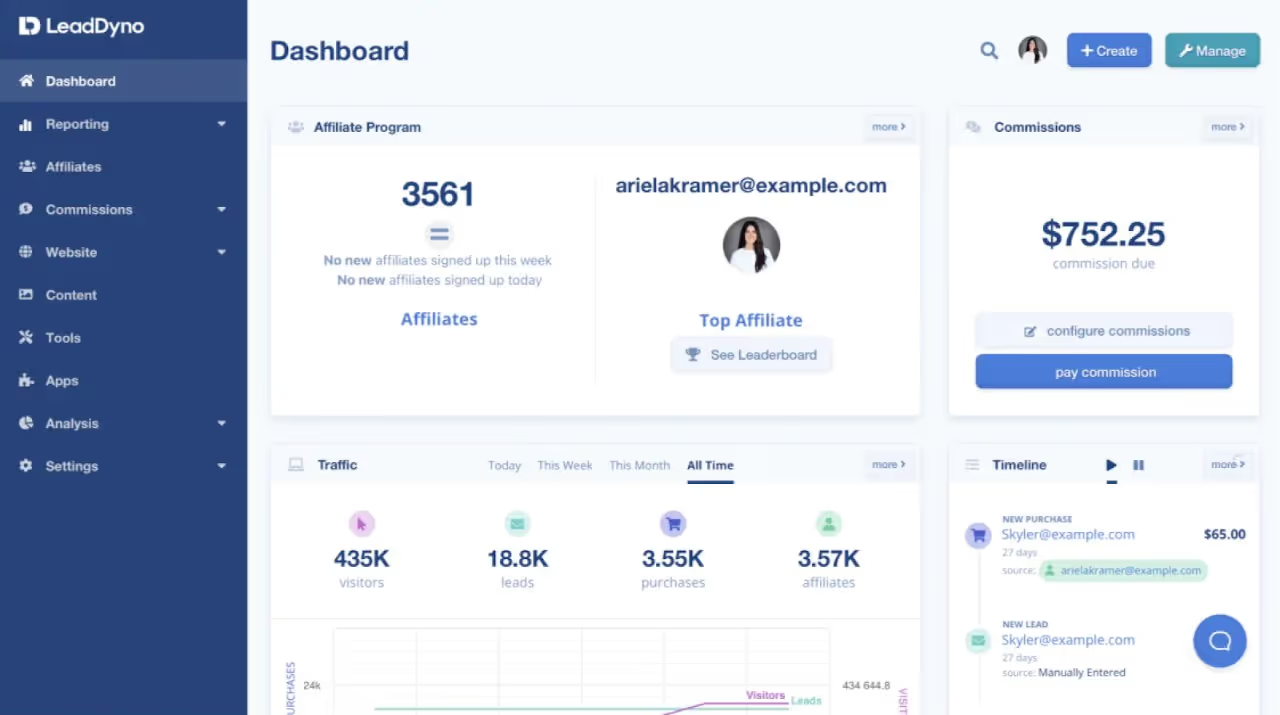
To get started, enjoy a free 30-day trial of LeadDyno here. You can also book a private demo of the LeadDyno platform or watch one on-demand here.
Conclusion
Choosing the right affiliate commission rates will go a long way in attracting the top-performing affiliates in your industry. Strong commission rates provide great incentive for affiliates to perform well, inevitably leading to an increase in conversions.
Raising your affiliate commission rates will give you a competitive advantage, attract the best talent, and ensure that your brand gets good exposure through quality backlinks.
The bottom line: Give your affiliate network the rewards they deserve, and they’ll pay you back in major sales.
.webp)

.svg)
Start a Free Trial
30 days free · Full Access
Cancel anytime
You might also be interested in...



Get Started Today
Launch your affiliate program with confidence thanks to our 30-day free trial. Begin building a program that delivers results.

